In addition to the class trophies there was a new competition of ‘Race for a Case', sponsored by leading family-run champagne house Billecart-Salmon: The crew of each class winner today won a case of their champagne while the owner took home (or drank immediately in celebration) a magnum of the finest fizz from Mareuil-sur-Aÿ.
Read moreENTRY OPEN FOR BRITISH CLASSIC WEEK 2026
Taking place from 20th to 25th July at Cowes Yacht Haven, the UK’s leading classic and modern classic yacht regatta continues to thrive as it heads into its 23rd year on the water.
Once again, the regatta committee has taken onboard the feedback from last year’s event as we continually refine and improve to deliver the best experience for sailors and guests.
This year, Race Officer Peter Saxton and his team at the Royal Yacht Squadron will see yachts compete in a five-race series of short inshore and longer, challenging courses.
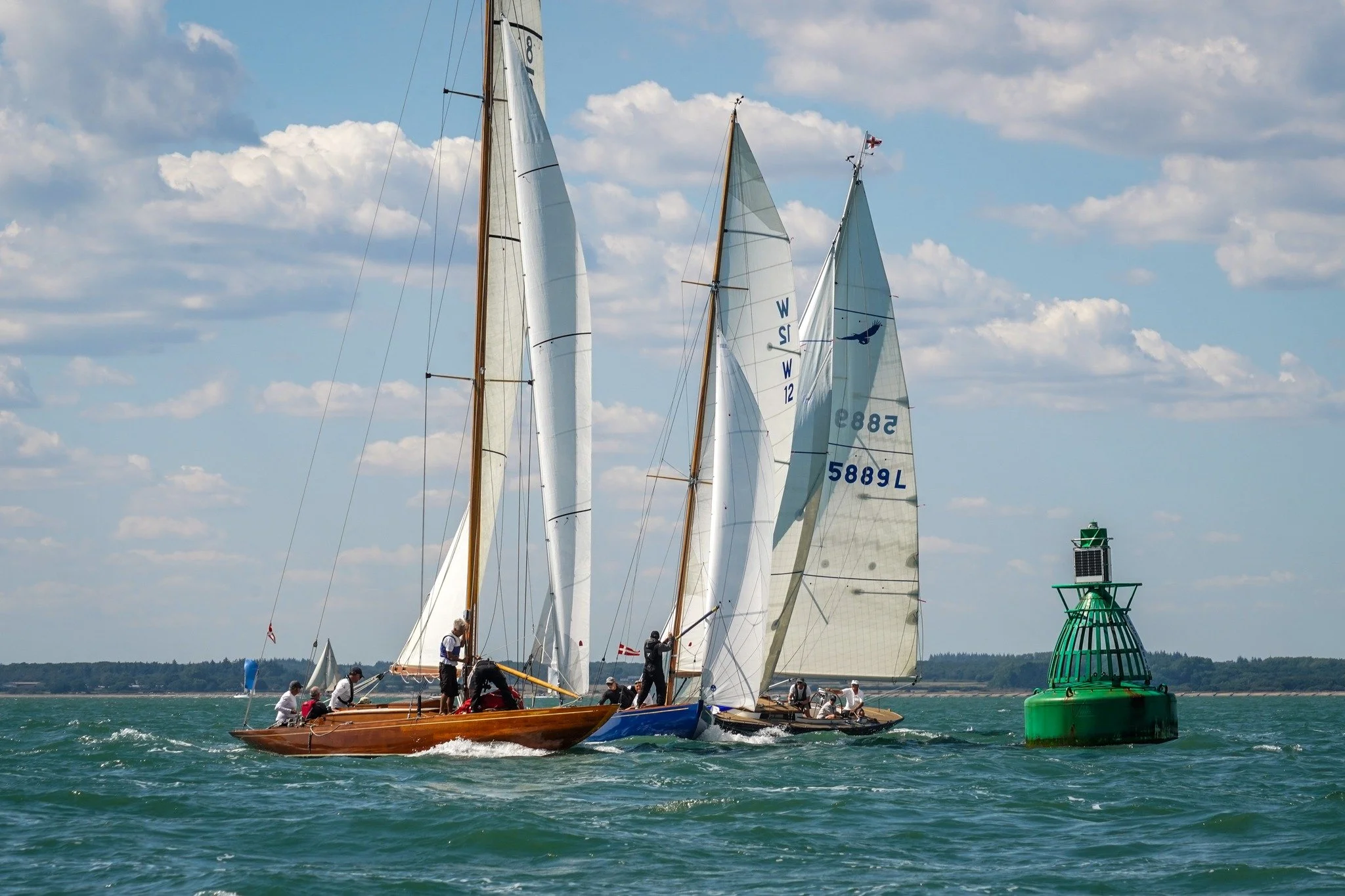
The week kicks off with round the cans racing sponsored by long-time regatta support Spirit Yachts, and welcome drinks at the iconic Royal Yacht Squadron in the evening – always a memorable way to start the week, meet new faces, and catch up with old friends.
Tuesday brings the Long Inshore Race, sponsored by OneSails GBR. The OneSails team will once again be providing a sail service centre throughout the regatta, and they are offering a generous 20% off Dacron and white 4T Forte sails (OneSails’ high performance, fully recyclable sail membrane) for regatta entrants only. *See below for details.
With every year of the regatta, our Female and Youth helm race (sponsored by Marineware and Awlgrip) grows in popularity and the competition on the water is fierce. We look forward to the exciting time pursuit format race on the Wednesday, before the famous ‘Open Yachts Pontoon Party’ at Cowes Yacht Haven in the evening.
Thursday sees Race 4 sponsored by Pantaenius Sail & Motor Yacht Insurance, followed by the Regatta Dinner and prize giving for our many traditional regatta trophies and prizes.
As ever, the programme has been designed around the tides, which means this year’s Around the Island race for the ‘offshore-capable yachts’ falls on Friday. We will retain the inshore racing for the “Solent” group (fast day-racers and lower handicapped boats. The week will round off with prize giving for the racing trophies and dockside drinks.
Valued sponsor and Cowes-based TOIO clothing will once again be offering a free embroidered jacket for each yacht, as well as their range of quality crew clothing, please contact their team directly once you have entered.
We are also grateful for continued support from Suffolk Yacht Harbour, Classic Marine, Broadfield Law, and Classic Boat magazine. Tall Ships Youth Trust returns for a fourth year as our charity partner, please give anything you can to help get young people out on the water.
The days are getting longer and lighter and before we know it the laying up season will be over, so make haste with those winter boat jobs and let’s get ready to go sailing!
BRITISH CLASSIC WEEK CONTINUES TO BUILD FOR 2026
REGATTA CHAIRMAN NEWSLETTER: After the roaring success and champagne sailing of the 2025 British Classic Week, which saw 52 classic and modern classic yachts - including original classic boats such as Summers & Payne gaff ketch Cariad, Frank Paine staysail schooner Viveka, and the “original maxi” and Fastnet 1961 line honours winner Stormvogel - the regatta team has been hard at work once again, building a programme for 2026 that will deliver a week of quality racing, socialising, and camaraderie.
With entries expected from across the UK and Europe, the regatta will be hosted at Cowes Yacht Haven, on the Isle of Wight, from 20th - 24th July, with racing from Monday to Friday.
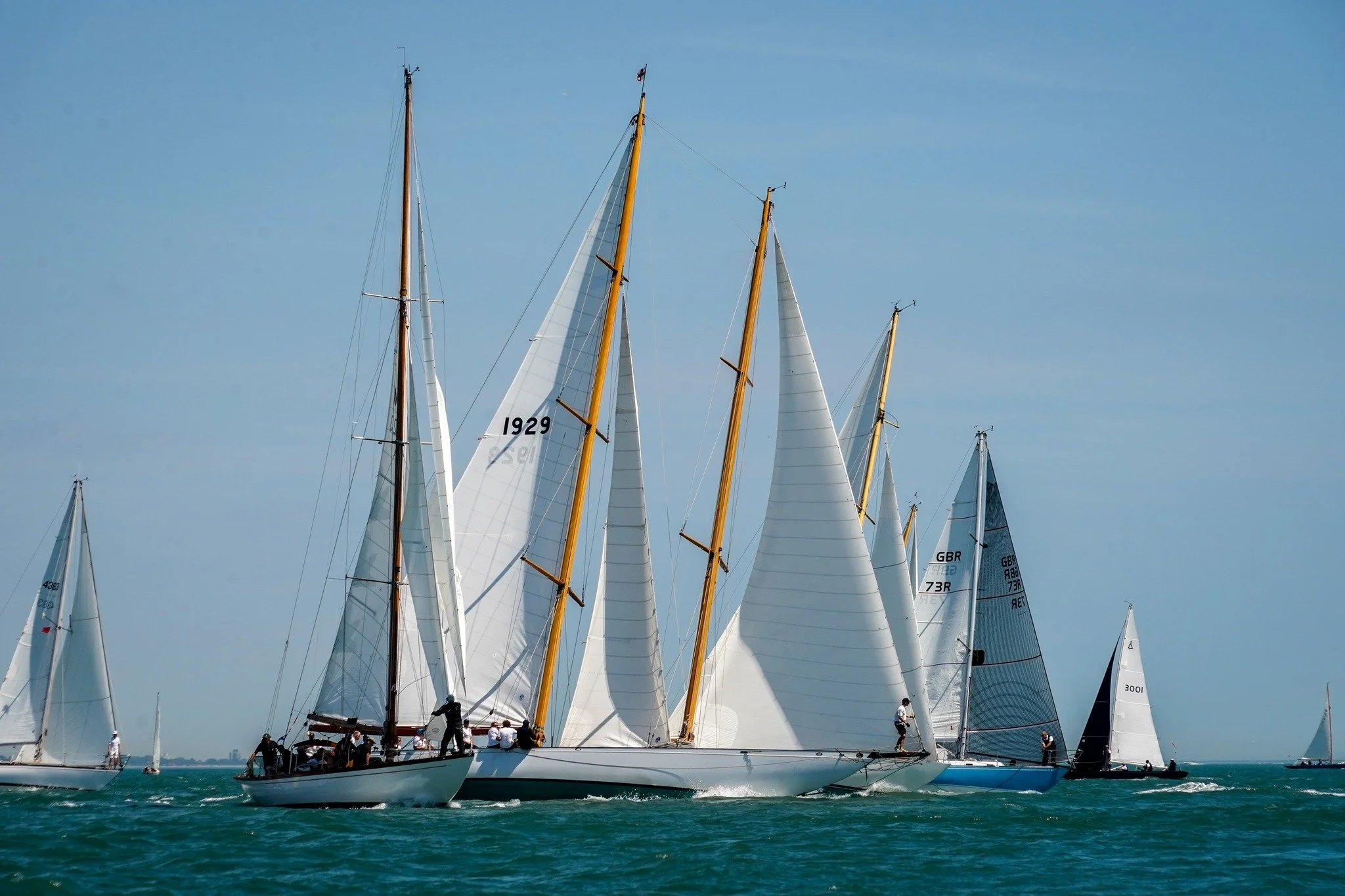
Peter Saxton and the Royal Yacht Squadron will once again provide world-class race management. The regatta will run a five-day series, including Round the Cans racing, a Long Inshore Race sponsored by OneSails GBR, and class racing sponsored by Spirit Yachts and Pantaenius Sail & Motor Yacht Insurance. The midweek highlight will be the Female & Youth Helm (Under 25s) Race - an exciting staggered-start pursuit race that will see the fleet finish en masse. The final-day spectacle will be a race around the Isle of Wight for the offshore-capable yachts, alongside an Inside Island Race for fast day-racers and lower-handicapped boats wishing to remain inside the Solent.
As always, the social scene ashore will be buzzing, with relaxed and inclusive events every evening that foster camaraderie and a traditional, classic regatta atmosphere. The event culminates in a fun prize-giving ceremony, featuring racing results awards as well as special awards for Gaffers, Spirit Yachts, and Vintage Standard Classics, along with the coveted Je ne sais quoi award.
Further lead event sponsorship comes from Suffolk Yacht Harbour, Classic Marine, and TOIO. Tall Ships Youth Trust returns for a sixth year as our charity partner, and we are grateful for any support you can give to help get young people out on the water.
Entry will open in mid-February. Please don’t hesitate to contact Jess or me with any enquiries, or to register your interest in the meantime.
Finally, on behalf of the regatta and my fellow BCYC committee members, I wish you a very Merry Christmas and a 2026 filled with fantastic sailing.
Best regards,
Giovanni Belgrano
Regatta Chairman
"BEST EVER" BRITISH CLASSIC WEEK FOR 2025
This year’s overall winners at the 23rd British Classic Week were Spirit 52 Happy Forever and West Solent One Design Enchanted. Based in Cowes on the Isle of Wight, British Classic Week welcomed 52 classic and modern classic yachts for a week of racing, socialising, and camaraderie.
Hosted by the British Classic Yacht Club (BCYC), with race management by Peter Saxton and the Royal Yacht Squadron team, the annual regatta saw stunning sailing conditions across the five-race series.
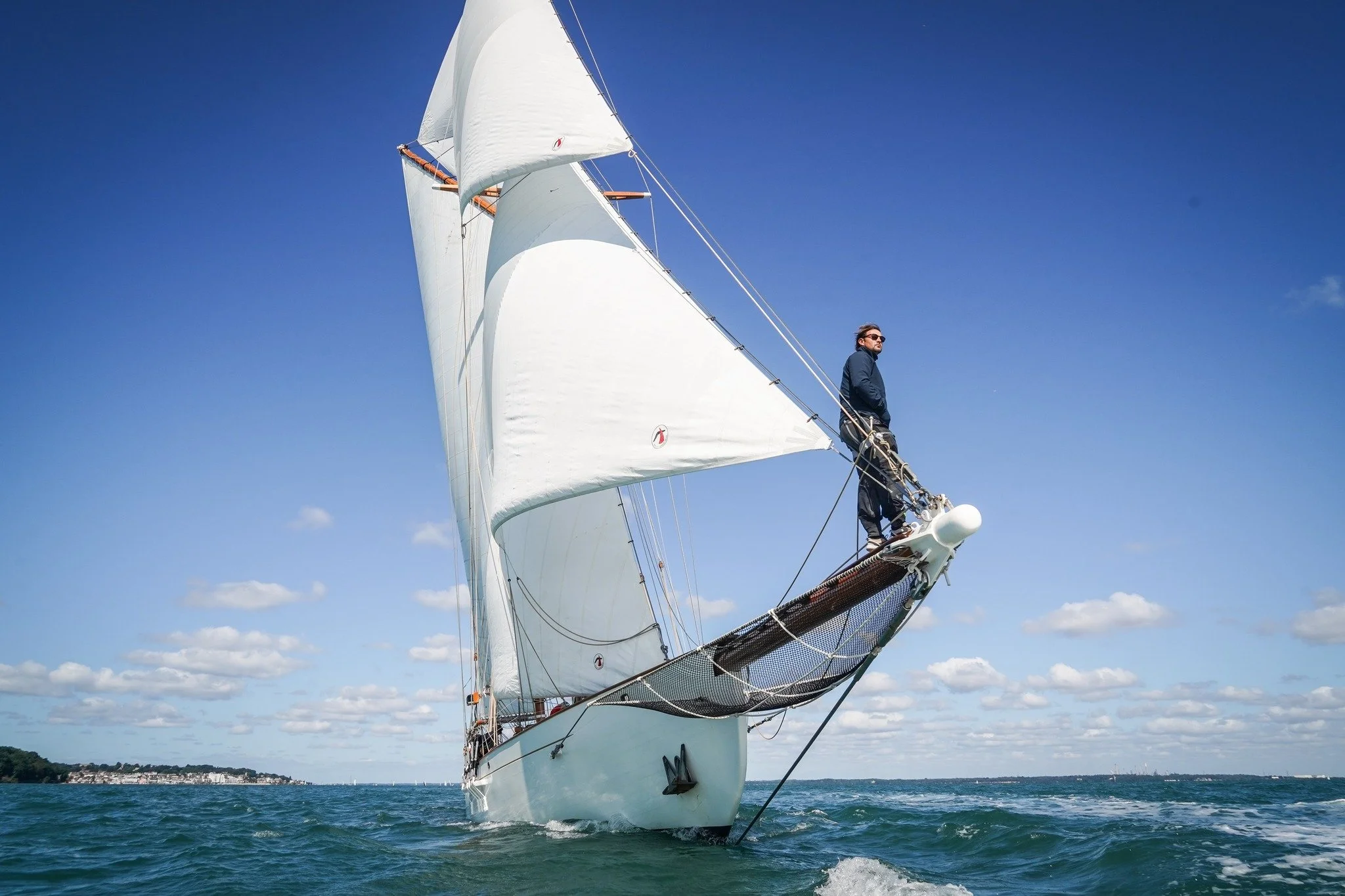
BCYC Regatta Chairman Giovanni Belgrano commented, “It was a spectacular week, arguably our best to date. Five consecutive days of champagne sailing – I cannot remember better regatta conditions. The weather, the quality of the racing, and the calibre of the classic and modern classic yachts was outstanding.”
The week began with a feeder pursuit race from the Royal Solent Yacht Club Taittinger Regatta in Yarmouth to British Classic Week in Cowes, which was won by Stella yacht Timoa. The regatta series began on Monday with round the cans racing sponsored by Spirit Yachts – of which there were seven at this year’s event, ranging from a Spirit R30 up to a Spirit C72.
Tuesday saw Classes 1, 2 and 3 take on the east-about Around the Island Race sponsored by Global Forecaster, while Classes 4 and 5 sailed a long inshore course in the Solent. Tidal conditions and a challenging ‘wind hole’ at St Catherine’s made the Around Island a race of two halves, but after a long day’s racing it was 10M Class Cutter Bojar that triumphed overall.
On Wednesday, the female and youth helm pursuit race, sponsored by Awlgrip and Marineware, took the fleet around the cans and into a tactical finish. At the race time limit, 22-year-old Victoria Theaker onTimoa took the overall win.
This year, the regatta attracted more young sailors than ever, including a family crew with five under 25s onboard Sparkman & Stephens Swan 40 Aleana, and youngest crew awards going to teenagers racing on Lak II, Flight of Durgan, Sioma, and Arctic Skua.
Inshore racing sponsored by OneSails GBR on Thursday was followed by the final day’s round the cans race sponsored by Pantaenius Sail and Motor Yacht Insurance in the eastern Solent.
Owner of West Solent One Design Enchanted, winner of Class 4 and the Overall Small Yacht of the Week trophy, Claire Locke, commented, “This was our third year of competing at British Classic Week and it has been absolutely brilliant. We have had peachy sailing conditions, and we are so pleased the work we have put into the boat over the last three years has paid off. Not only that, but it was also incredible to have four West Solent One Designs racing together – a fantastic moment for the class.”
This year’s fleet included 1894 Thames Rater Dorothy (owned by Olympic sailor Ossie Stewart), gaff cutter Peggy Bawn (also 1894), and the iconic 36m Summers & Payne gaff ketch Cariad, built in 1896.
Navigator on Cariad and former skipper of the famous Fife yacht Mariquita, Jim Thom, said, “This has been one of the best regattas I have ever attended. The event organisation and race management have been excellent.”
Giovanni Belgrano added, “We are a regatta organised by sailors for sailors. We are not professional event managers, but we know better than most what makes for a memorable regatta experience. We will keep pushing to improve and to continue to attract the best classic yachts and sailors out there.”
Further race and shoreside support came from Suffolk Yacht Harbour, Classic Marine, TOIO clothing, Broadfield Law, Bainbridge International, Classic Boat magazine, and Hattiers Rum. The regatta continued its partnership with Tall Ships Youth Trust with fundraising throughout the week.
At the end of the regatta, Christian Oldendorff’s Spirit 52 Happy Forever won Class 1 and the BCYC Yacht of the Week trophy. Staysail schooner Viveka, owned by Keith Mills (British entrepreneur and deputy chairman of the London Organising Committee of the Olympic and Paralympic Games) won Class 2 overall. Class 3 was won by Laurent Giles designed sloop Whooper. Claire Locke in Enchanted triumphed in Class 4 and took the BCYC Small Yacht of the Week trophy. Class 5 was won by Andrew Gilmour inTimoa, who took four class wins out of five races. Thames Rater Dorothy won the Gaffer Class overall.
For the full set of results, click here. The dates for next year’s British Classic Week are 20th – 25th July 2026.
ONESAILS INSHORE RACE ON DAY 4 AT BRITISH CLASSIC WEEK
It was a classic Solent day in Cowes for day four of British Classic Week with hot temperatures, sunshine and little to no wind in the morning before the sea breeze kicked in from the west and it was time to go racing.
Race four, sponsored by OneSails GBR, saw classes 1, 2, and 3 start together off the Royal Yacht Squadron (RYS) inner line to the west in glorious sunshine and 10-12 knots.
Onlookers on the shore were treated to fast-paced action as most of the yachts started on starboard and almost immediately had to tack off out of the shore on to port into the oncoming starboard tackers. Once clear of the shore, yachts made the most of the west-going tide and beat out into the central Solent for the long leg up to Power Byrne. Tacking around Powder Byrne to port, it was a tight reach south west to Solent Bank.
With a strong west-going tide, tacticians had to carefully judge the port rounding of Solent Bank to avoid being swept down onto the mark as they hoisted spinnakers, gybed and set off for the mainland shore to get out of the tide.
Rounding West Lepe to starboard, the yachts beat back upwind to Hamstead Ledge, before a beautiful long run close inshore out of the tide passing Monex Marine and Polly’s Challenge and on to finish at the RYS line.
Meanwhile, classes 4 and 5 also started together on the RYS inner line, taking a similar first leg beat with the tide to the west to Craftinsure. Rounding Craftinsure to port and tucking themselves inshore as soon as possible, classes 4 and 5 took Gurnard Ledge to starboard, again judging the strong west-going tide carefully upon rounding.
A beat to Salt Mead preceded a champagne sailing downwind leg inshore back to the RYS line, passing Monex Marine and Polly’s Challenge and their way.
The winners of Race 4 sponsored by OneSails GBR were Spirit R52 Flight of Durgan in Class 1, 10Metre Bojar in Class 2, Laurent Giles designed Whooper took Class 3, West Solent One Design Enchanted won Class 4, and Timoa made it a clean sweep with her fourth class win of the week in Class 5.
FEMALE / YOUTH HELM RACE ON DAY 3 AT BRITISH CLASSIC WEEK
Day three at British Classic Week in Cowes brought the annual Concours d’Elegance parade and the female and youth (under 25yrs) helm race sponsored by Marineware and Awlgrip.
It was a beautiful day in Cowes for the third day of racing for the 51 classic and modern classic yachts at British Classic Week. Following the traditional parade in front of the Royal Yacht Squadron, the female and youth helm race began in a pursuit format in 18 knots of wind from the west.
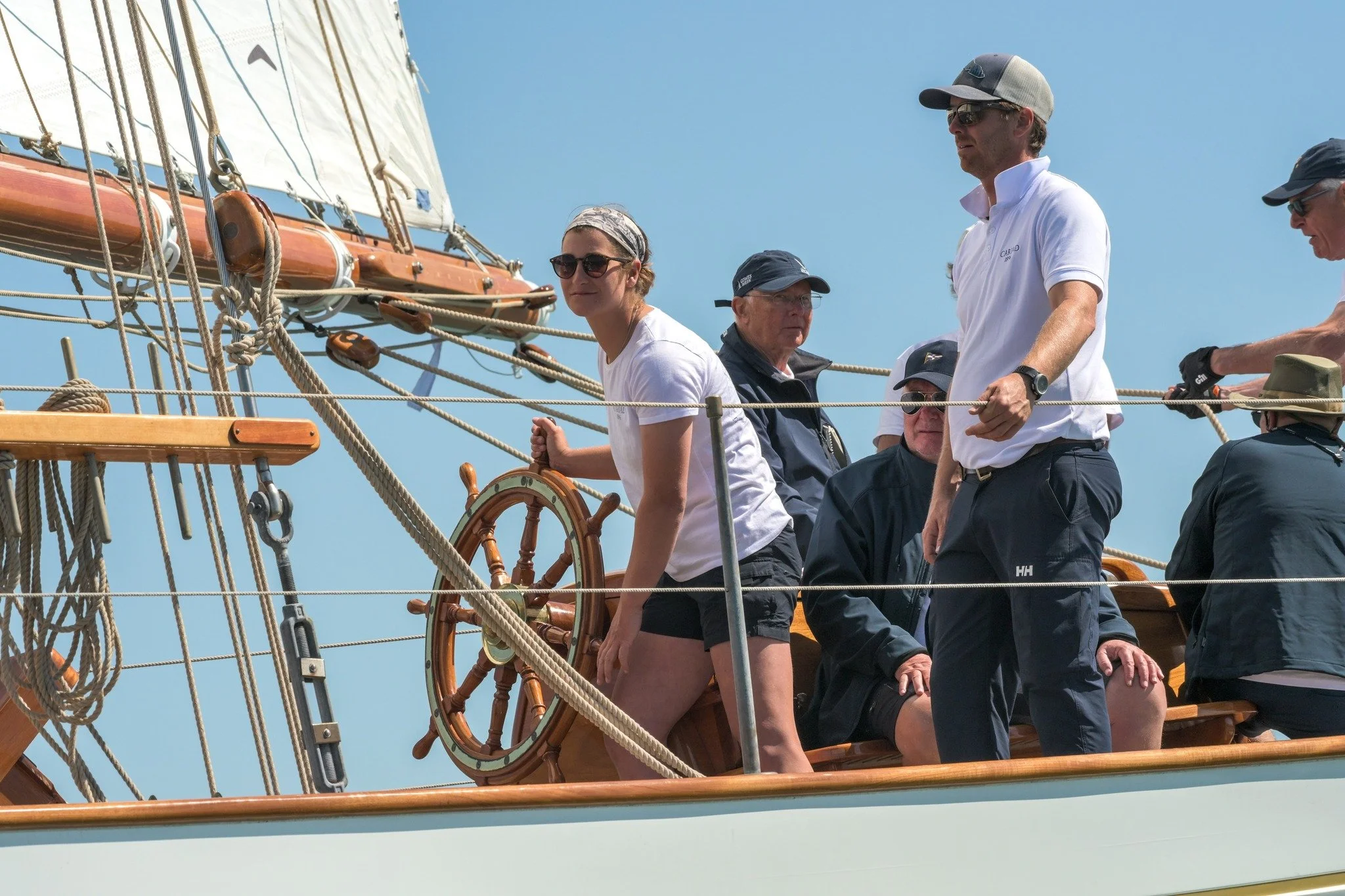
The yacht with the lowest handicap in the fleet, 1961 long keel sloop Allegra del Mar, was the first yacht to set off, followed 63 minutes later by the final yacht to start, Spirit C72 Gwenhyfar II and the race was on.
Beating with the tide to the west, the fleet sailed to East Lepe, rounded the mark to port and carried on tacking up the Solent – hunting down the yacht in front – to Newton East.
Broad reaching across the tide with spinnakers up, dropping as they rounded Craftinsure to port, the yachts set off on a long beat up in fair tide to Draycott Chartered Surveyors.
Seventeen year old Ruby Sunderland, helming Spirit R52 Flight of Durgan commented, “It was a really good race. It was different because the boat has a wheel rather than a tiller, so that was a new experience for me, but she is such a nice boat to steer. The downwinds were fun, we were right in shore. It was very interesting race as we were just getting closer to everyone as the race went on – it was a great day.”
Rounding Draycott Chartered Surveyors to starboard, it was a big bear away and spinnakers up to begin the long downwind leg via Zwerver and Powder Byrne. With a race finish time set for 1600 and the tide against the fleet, it was still all to play for in the last 30 minutes of the race. As the final third of the fleet approached Power Byrne against the tide, time was called on the race and positions were taken.
John Parker of OneSails GBR, racing on Spirit R52 Flight of Durgan, commented, “It was rare in a conventional yacht race that you spend time with so many yachts around you, and this made it a unique racing environment. We had yachts of different sizes, classes, and handicaps around us for the whole race, it made for a fantastic spectacle on a beautifully sunny day in the Solent.”
Back on the down, sundowners were served courtesy of Marineware and Awlgrip as the crews prepared their yachts for the evening’s Pontoon Party sponsored by Classic Boat magazine.
The second smallest yacht in the fleet, Stella Timoa helmed by Victoria Theaker took the overall win. Class 1 was won by Spirit R52 Flight of Durgan, staysail schooner Viveka won Class 2, Swan 36 Scherzo took Class 3, Claire Locke on West Solent One Design Enchanted took her third class win of the week in Class 4, and Timoa won Class 5.
BRITISH CLASSICS GO AROUND THE ISLAND ON DAY 2
It was an early start for the British Classic Week fleet on day two, as Classes 1-3 prepared to race around the Isle of Wight.
Sponsored by Global Forecaster, racing began with class starts on the Royal Yacht Squadron line to the east. Sailing with the tide, and with up to 15 knots of wind from the North, it was a challenging tight reach down the eastern Solent for the first 10nm.
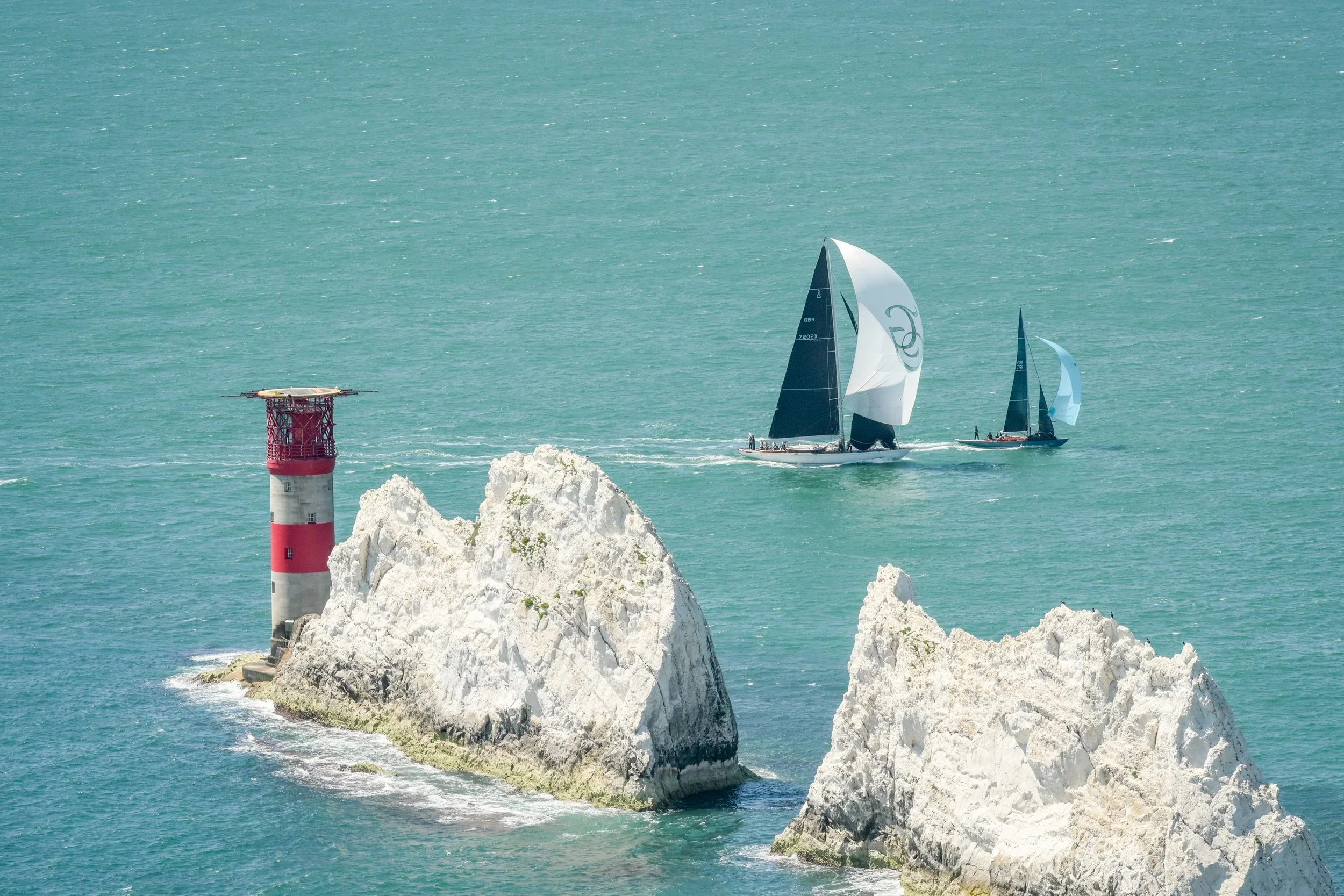
As soon as the wind angle allowed, spinnakers were hoisted on the bear away as the fleet was met with lighter conditions along the Seaview coastline.
Giovanni Belgrano, winner of Class 3 on Whooper, commented, “By Seaview we were in a tricky, choppy sea. It was difficult to steer and keep the boat going well.”
Giovanni added, “We gybed at Bembridge and pushed hard as we didn’t know what we would face at Ventnor and St Catherine’s. We debated whether to go high and hope for breeze under the cliffs or to take the rum line. In the end, we stayed inshore and it paid off. There was less breeze, but we wriggled through before the big wind hole came in.”
The yachts behind weren’t so fortunate, with one crew member from Spirit C72 Gwenhyfar II commenting, “The race was reset at St Catherine’s as we all bunched up when the wind died.”
Once they got clear of St Catherine’s, the breeze filled in and the fleet had a glorious upwind leg with the tide and strong currents pushing them to the Needles in 10-14 knots and bright sunshine.
Rounding the Needles and hoisting spinnakers as they went, most of the fleet were faced with the still oncoming tide on the homeward leg back to Cowes. Tucking close inshore as the wind steadily built, the yachts tucked into the island shore to dodge the tide.
Giovanni added, “We stuck to the island shore and benefitted from the gusts coming off the island due to the hot weather, this helped us along. Normally it makes sense to go North and come across to Cowes but this time it worked to stay island-side.”
The final run into Cowes was champagne sailing with Code Zeros and spinnakers decorating the Solent horizon as the yachts crossed the RYS line.
In the meantime, Classes 4 and 5 took on a long inshore course in the Solent, starting to the west and tight reaching against the slackening tide all the way up to Hurst. Conditions were challenging as the wind died for the long leg back into the central Solent and across to South East Ryde Middle, taking a circular course around Royal Yacht Squadron, Hamble Yacht Services, and Team O before heading back down to the RYS line to finish alongside the mid-fleet around the island yachts.
A well-deserved cold beer on the dock was enjoyed by all courtesy of Bainbridge Sail Cloth after a long but memorable day on the water.
Race 2 was won by Spirit 52 Happy Forever in Class 1, 10M Bojar in Class 2, and Whooper in Class 3. In the long inshore, West Solent One Design Enchanted took Class 4, and Stella Timoa won Class 5 – both yachts taking two class wins from two races.
BRITISH CLASSIC WEEK 2025 KICKS OFF WITH CHAMPAGNE SAILING
Day one at British Classic Week in Cowes saw fast-paced racing around the cans sponsored by Spirit Yachts for over 50 classic and modern classic yachts.
Organised by the British Classic Yacht Club with race management by the Royal Yacht Squadron (RYS), British Classic Week brings together some of the finest classic and modern classic yachts from across the UK and Europe.
Northerly winds gusting 22 knots saw racing delayed by an hour for Classes 1 to 5. Starting on the RYS line to the west in a short Solent chop, Classes 4 and 5 set off on a 10nm course upwind with the tide to The Boss.
Rounding The Boss to port, it was champagne sailing with spinnakers up as the sun broke through on the downwind leg to Monex Marine. Rounding the mark to port, Classes 4 and 5 sailed a short leg to the east along the Isle of Wight shore to Salt Mead.
Rounding Salt Mead to starboard, Classes 4 and 5 set off upwind across the Solent to West Lepe, followed by a powered-up reach with the turning tide to Cowes Week. Bearing away around West Lepe some yachts hoisted kites for a broad reach back to the RYS line.
Owner of Race 1, Class 5 winner Timoa, Andrew Gilmour, commented, “Good call by Peter Saxton (PRO) and the team to delay the start to let the front go through. Great sailing in sunshine and around 15kn of shifty breeze from the north. Sailing short legs at all angles to the wind suited the classics - a great day on the water.”
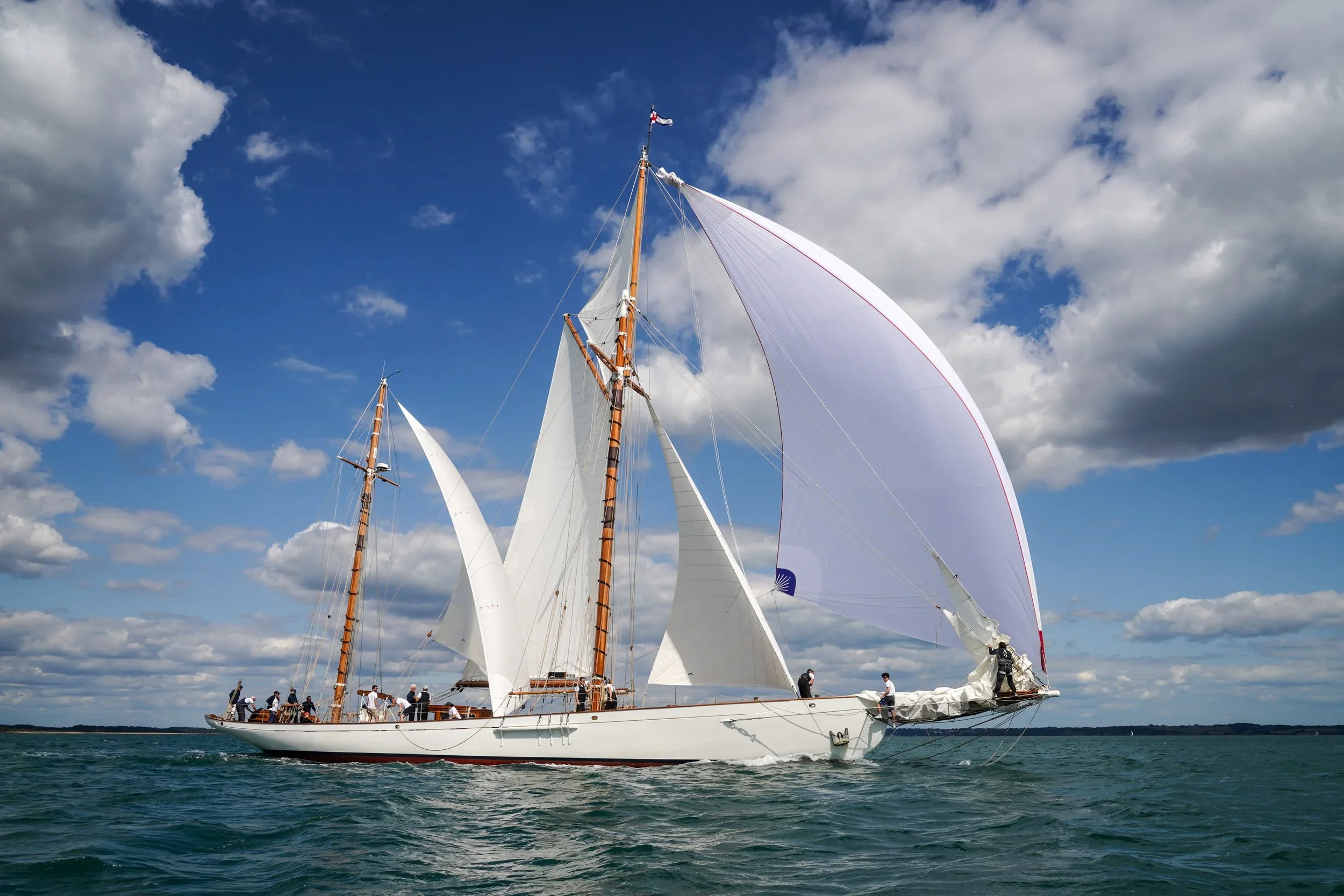
Sailing a similar course, Classes 1 to 3 set off on class starts from the RYS line to The Boss. It was a fantastic spectacle for passing cruising yachts with everything from modern classic Spirit Yachts to 36m gaff ketch Cariad and the iconic 1929 staysail schooner Viveka owned by Sir Keith Mills.
Rounding The Boss to port, the yachts hoisted spinnakers and sailed a stunning downwind leg in 10-12 knots to Monex Marine. Dropping spinnakers and rounding up around Monex Marine to starboard, it was a reach on to Newton East. A series of windward leeward legs followed, before Classes 1 to 3 sailed a long reach homeward from Zwerver to Cowes Week, where spinnakers were hoisted for the final leg of the 18nm course to the RYS line.
Upon arrival back at the dock, regatta sailors were treated to Nyetimber sparkling wine courtesy of Pantaenius Sail and Motor Yacht Insurance.
Race 1 was won by Spirit 52 Flight of Durgan in Class 1, Viveka in Class 2, Regatta Chairman Giovanni Belgrano in Whooper won Class 3 (by only 37 seconds on corrected time), West Solent One Design Enchanted took Class 4, and Stella Timoa won Class 5.
BRITISH CLASSIC WEEK ANNOUNCES STRONG ENTRIES FOR 2025
British Classic Yacht Club (BCYC) has announced a stellar fleet of entries for its annual British Classic Week regatta in Cowes. With ‘Early Bird’ entry now closed, the regatta has 32 classic and modern classic yachts signed up at the time of writing with less than two months to go until the event.
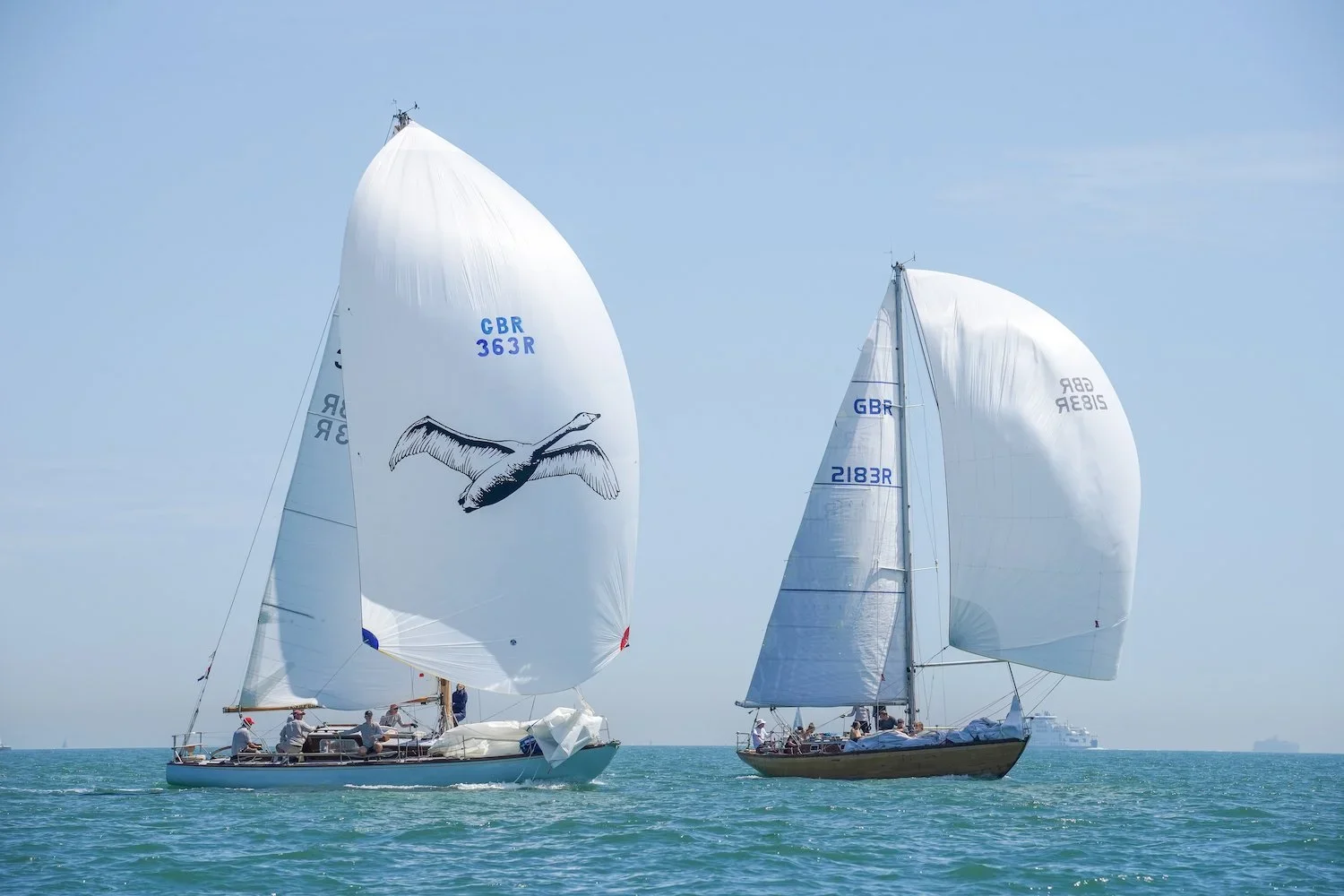
The entry list spans build dates from as early as 1896 to modern classics launched in the 21st Century. The fleet currently has five yachts over 65ft, including original classics boats such as Summers & Payne gaff ketch Cariad, Frank Paine staysail schooner Viveka, and the ‘original maxi’ and Fastnet 1961 line honours winner Stormvogel.
Regatta Chairman Giovanni Belgrano commented, “This year’s regatta is attracting many special new entries from across the UK and overseas. The calibre of the yachts and their sailors is set to make for exceptional sailing and unforgettable memories on the dock.”
Pedigree yachts also signed up to take on the five-race series include 1924 Bermudan sloop Suvretta, 1904 Fife-designed Clyde 30 Linear Rater Mikado, and West Solent One Designs from the 1920s.
Taking place from 6th to 11th July, based at Cowes Yacht Haven, British Classic Week comprises a varied programme of racing run by the prestigious Royal Yacht Squadron. Race sponsors providing invaluable support are Spirit Yachts, OneSails GBR, Global Forecaster, Marineware and Awlgrip, and Pantaenius Sail & Motor Yacht Insurance.
Giovanni Belgrano continued, “This year’s regatta offers the opportunity to be a part of one of the biggest sailing summers in UK waters for quite some time. There is still time to enter, but we have an event capacity so sign up soon to avoid disappointment.”
Alongside the sailing, the shoreside scene promises to be as lively as ever with the famous dockside parties, a reception at the Royal Yacht Squadron, and a more relaxed Regatta Supper, with plenty of opportunities to catch up with old friends and meet new faces.
Further race and event sponsorship comes from TOIO marine apparel, Suffolk Yacht Harbour, traditional chandlery Classic Marine, Hattiers Rum, Raymarine, and Bainbridge sail cloth.
ENTRY OPEN FOR BRITISH CLASSIC WEEK 2025
The British Classic Yacht Club (BCYC) have announced the details for British Classic Week 2025. Entry for this year’s event is now OPEN!
Taking place from 6th to 11th July at Cowes Yacht Haven, the regatta is slightly earlier this year to make way for the iconic return of The Admiral’s Cup.
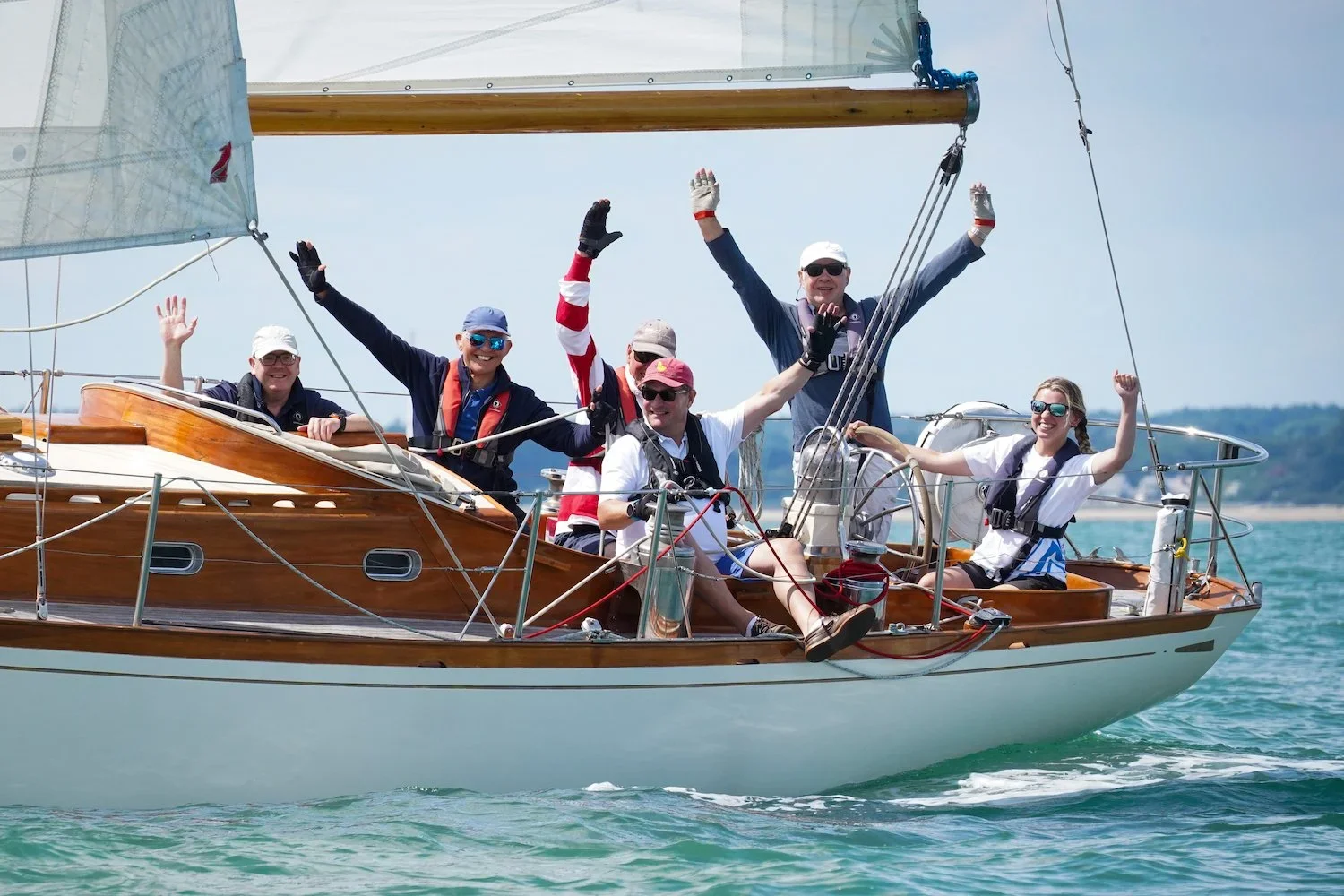
Last year, the regatta’s new format was met with overwhelming positive feedback, so the 2025 event will be run the same again with small refinements. Early expressions of interest have been flooding in and yacht owners are encouraged to submit entry promptly to avoid missing out as there is an event capacity limit.
Race management from Peter Saxton and his team at the Royal Yacht Squadron will see yachts compete in a five-race series. This year’s regatta will be kicked off by the usual Concours d’Elegance before racing gets underway with a round-the-cans race sponsored by Spirit Yachts. Tuesday 7th will bring a race around the Isle of Wight sponsored by Global Forecaster. To increase the chances of ‘going around the island’, the regatta organisers have divided the fleet into “Offshore-capable yachts” (with self-draining cockpits), and a “Solent” group (fast day-racers and lower handicapped boats). The race office plan to send the offshore-capable group around the island and deliver competitive and safe inshore racing for the Solent group.
Later in the week, the regatta will hold a new Female/Youth Helm (under 25) Pursuit Race sponsored by Marineware and Awlgrip, and the Long Inshore race sponsored by OneSails GBR. The week will round off with Race 5 in the Solent, sponsored by Pantaenius Sail & Motor Yacht Insurance.
The shoreside scene will focus on a relaxed, friendly atmosphere with plenty of opportunities to share stories from on the water and socialise on the fleet beautiful yachts. The popular Pontoon Party makes a return as well as welcome drinks at the Royal Yacht Squadron. This year, we will host a prize giving dinner on Thursday 9th with racing trophies awarded in the afternoon on Friday 10th July.
Thanks to valued sponsors there are some fantastic offers for regatta entrants this year. Cowes-based TOIO clothing will once again be generously offering a free embroidered jacket for each yacht.
Long-standing regatta supporter OneSails GBR is offering 20% off Dacron and white 4T Forte sails (OneSails’ high performance, fully recyclable sail membrane) for regatta entrants only.*. As well as the discount on sails, OneSails will be running a sail repair service during the regatta and the opportunity to drop off your old sails, which they will recycle or upcycle.
Continued support comes from Suffolk Yacht Harbour, Classic Marine, Broadfield Law, Bainbridge sailcloth, Classic Boat magazine, and Hattiers Rum. Tall Ships Youth Trust returns for a fourth year as the charity partner, and event attendees are asked to give anything they can to help get young people out on the water.
So shake off those winter blues and let’s get ready to go sailing!
*OneSails offer is for British Classic Week entrants only, delivery of sails is minimum 12 weeks from order date, offer is valid until 31st December 2025. Contact east@onesails.co.uk or south@onesails.co.uk
ENTRY OPEN FOR ‘NEW LOOK’ BRITISH CLASSIC WEEK 2024
British Classic Yacht Club (BCYC) has announced entry is open for its annual British Classic Week regatta in Cowes. Alongside opening the entry, BCYC has revealed new event management and fresh changes to the format of the regatta.

Taking place from 15th to 20th July, the regatta will run from Monday to Friday allowing yachts and crew more time for logistics over the weekends either side. For owners keen for extra racing, British Classic Week has teamed up with the Taittinger Regatta (12th – 14th July in nearby Yarmouth) to offer a feeder/passage race between the two events on Sunday 14th July.
Incoming BCYC Regatta Chairman, Giovanni Belgrano, commented, “We have put a lot of work into analysing the regatta to make it more enjoyable on the water and ashore. Our new, refreshed programme offers varied, ’classic-friendly’ racing, lots of socialising, and a stable, sustainable model for the future of the regatta.”

As well as changes to the format, BCYC has unveiled details of new eligibility criteria for entry. As per previous years, entries are invited from classic yachts built of wood, steel, or aluminium to either a pre-1970 design or modern classic yachts built with the appearance of a classic. This year, applications from classic or Spirit of Tradition GRP yachts will also be considered. The regatta continues to welcome gaff-rigged yachts and aims to host a dedicated class programme.
Cruising yachts and classic motor boats are invited to join the Concours d’Elegance Parade, watch the racing, explore local waters, and enjoy the social events at the regatta’s base at Cowes Yacht Haven.

Giovanni continued, “The original ethos of British Classic Week was to have the best sailing on the water no matter your level of experience and to come ashore for informal, good quality fun with friends. With our new approach we are going back to our roots, and we invite classic yacht owners, crew, guests, and spectators to get involved. We already have a lot of interest from across the UK and Europe, so it’s set to be a fantastic event.”
Racing entrants will take on a five-race series organised by the Royal Yacht Squadron.
The programme includes a coastal race sponsored by Spirit Yachts, which takes yachts east through the Solent Forts. Weather permitting, there will be a race around the Isle of Wight sponsored by Global Forecaster (with a back-up ‘Inside Island’ course, or a shorter around the cans race if it’s light winds).

The Long Inshore race sponsored by OneSails GBR will offer further opportunity for the yachts to stretch their legs alongside a beautifully maintained fleet of classics. To round off the week, an innovative pursuit race is planned for Friday 20th July.
The regatta maintains its commitment to opportunities for women in sailing with its female-helm race, which is followed by the infamous ‘Pontoon Party’ in the evening. The party is sponsored by Classic Boat magazine with drinks from Dartmouth Gin and Hattiers Rum.

Further race and event sponsorship comes from Suffolk Yacht Harbour and traditional chandlery Classic Marine.
In addition to the Pontoon Party, the social programme sees popular events retained such as welcome drinks at the Royal Yacht Squadron and the final prize giving dinner. Dock parties organised by the various classes will undoubtedly bring a lively addition to the shoreside scene.

The regatta also continues its ongoing partnership with the UK’s oldest and largest youth development sail training charity Tall Ships Youth Trust. The collaboration raises awareness and funds for the charity’s work helping disadvantaged young people to fulfil their life potential through adventures at sea.
Entry is now open, go to www.britishclassicweek.co.uk
KINGFISHER GOES HOME - SUMMER IN SCOTLAND 2022

Kingfisher anchored in Craigaig Bay, Ulva
Narrative log of her Summer Cruise, August and September 2022
Introduction
Kingfisher is a 42 ft Silver Leaf motor yacht, designed by John Bain and built at Silvers in the Gareloch in 1935. Apart from a short spell at Rhu in the 1980s she has not revisited her place of origin, or the cruising ground for which she was designed. Since the Western Isles of Scotland have for many years been our favourite cruising ground, and since she does duty as mother-ship to our Fife cutter Mikado, competing in the 2022 Fife Regatta on the Clyde, we thought it was high time for Kingfisher to have a season in Scotland.
So we trucked her up to Largs in May, for a 2 week Whitsun shake-down cruise to Northern Ireland (Cambletown, Belfast and Strangford Lochs, then Glenarm, Rathlin Island and Loch Ranza) before doing her appointed duty at the Fife Regatta in early June.Then she lay at a buoy in the Gareloch off the Royal Northern and Clyde Yacht Club until the end of July, in plain sight of her birthplace across the loch at Rosneath.Silvers is still an active boatyard but ceased building its famous range of wooden motor yachts in 1971.

Doing her mother-ship job at the Fife Regatta
This was our fourth Fife Regatta, at which Fife’s yachts gather from around the world for a week’s racing in the Clyde (where they were all built). Each time we have left Mikado there at the end of the regatta (or nearby at Crinan or Loch Melfort) for a summer cruise. This time Mikado was sent back for events in the Solent, while Kingfisher remained to give us a more comfortable Western Isles cruise, a more suitable cruiser than Mikado for our advancing years and all the vicissitudes of Scottish weather. This log describes that cruise, which ran for a little over five weeks from the end of July. We hesitate to call it a summer cruise, since many would say that North West Scotland just didn’t have a summer in 2022, while the rest of the UK basked (or maybe baked) in the hottest, driest, summer since 1976.
Five weeks is too long to give a strict day by day account of our travels. So this log is arranged by reference to where we went and/or stayed. One of the blessings of having more than a month to cruise is the choice it gives you between moving on and staying put to enjoy a particular place or area in more depth. And you can wait for adverse weather to pass before you move on. In the event we had no full gales to ride out, although the weather was, to say the least, mixed. There were few days without some rain or fog (or that unique mixture of the two which the Scots call ‘smurrin’). And there was a very large range of wind, from force 6-7 to flat calm, all of which Kingfisher took in her stride. Very little of it was on the nose, and there were few occasions when we couldn’t find a sheltering windward shore when necessary to make a planned passage more comfortable. With her enclosed wheelhouse and central heating Kingfisher made sure we never got wet or cold. And with her excellent sea-keeping and steadying sail we never got sea-sick either, or even queasy, and none of her crockery got smashed. We met a number of friends, and made several new ones on the way. But the permanent crew was just the writer (Michael) and my wife and co-owner Beverly. We have come to a comfortable arrangement under which I am the captain (running the ship) but Beverly is the admiral (who tells the captain where to go, and makes all the critical restaurant bookings). We share the watchkeeping, cooking, provisioning and everything else on board. No individual passage took longer than about five hours, so watch-keeping wasn’t really a requirement.

The Admiral and the Captain
Gareloch to Crinan
Trains from London to Glasgow and then Helensburgh, and a short taxi ride after provisioning got us to the Royal Northern by early afternoon on 30 July, to be taken out to the mooring by Douglas the club boatman. Apart from bird droppings Kingfisher looked OK after her six week stay. In fact Douglas and Reay Mackay the club’s moorings officer had kept a careful eye on her during that time, for which we were very grateful. There was a slight moustache of weed on the boot topping, but nothing which couldn’t be cleaned off with a scrubbing brush from the dinghy.
A peaceful late-afternoon passage round to the Kyles of Bute via Hunter’s Quay (where Mikado had been moored from 1904 to 07) revealed however that she was achieving at least a knot less than her expected speed for given cruising revs of 2,200, little more than 6.5 kts rather than the usual 8 kts.But it wasn’t till an exploratory look from the dinghy in the beautiful little Caladh harbour (just west of the Kyle narrows) that badly barnacled screws emerged as a likely culprit.Poking at them with an oar blade scarcely scratched the surface of the problem.

Caladh Harbour
Some say that a foul bottom or screws isn’t a problem to worry about on a motor yacht. You just pile on a few more revs to make up for it. But the thought of burning unnecessary fuel offends my abhorrence of global warming or just plain parsimonious instincts, so something had to be done about it.
But first we wanted to get North into our real cruising ground, and that meant traversing the lovely Crinan Canal.We had an uneventful, mainly sunny passage the next morning against a light to moderate headwind, arriving at the Ardrishaig sea-lock by 1115, and reaching the half-way point in the canal at Cairnbaan by 1500.There, coming the other way, we met Kenny and Sonia Smyth in their pretty 1962 Holman 31 footer Casino.Kenny runs a boatyard in Strangford Loch (NI) where he also races a River class wooden dayboat.He remembered Mikado being based there in the 1970s.We had a convivial supper with them at the Cairnbaan Hotel, watching the Lionesses beat Germany in the football final, to everyone’s great joy.

The Admiral with Kenny and Sonia
Ardfern
We had planned to meet our great friend Sally Bergius at some convenient place en route.She and her husband Frank have a farm on the banks of Loch Awe, so Ardfern seemed an ideal meeting point. 1st August started sunny, as we climbed the stair of locks above Cairnbaan, arriving in Crinan Basin just in time for a delicious lunch of local halibut , and to watch the famous puffer Vic 32 getting up steam.
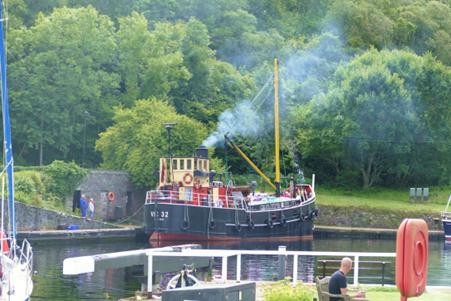
Vic 32 raising steam at Crinan Basin
The descent from the top reach, with increasing amounts of Loch Crinan in sight, always raises the spirits as it reduces our altitude, and this time was no exception. We locked out at 1410, in a rising wind, with black clouds forming to windward. It’s only a few miles to Ardfern, but the rain had started in earnest by the time we arrived at 1530, initially having to moor outside the breakwater because all the visitor berths were full. Luckily an available space later saved us a lot of wet dinghy-work in the rain, and Sally was able to come to supper on board dry-shod.This was the first of 3 days at Ardfern.
On the following day (2nd August) we took another friend Louise Robertson for a day trip.She had come all the way from Perth to see us.It was windy (from the South West) and initially wet as well, but we had a cracking passage over to Jura via the Dorus Mor, to Port an Tiobart,a tiny bay just south-east from the infamous Gulf of Corryvreckan, where we anchored very close in to escape the roaring tide and most of the swell.We returned to Ardfern via the Ruadh Sgeir ledges, a supposedly calmer route than the Dorus Mor, but the angry wind-over-tide sea didn’t seem much less forbidding.A tea-break inside Eilan Nan Gabhar on the way back was interrupted by the surprise arrival a flotilla of school training yachts.

Overfalls and gulls at the Ruadh Sgeir Ledges
By this time we had booked a haul-out on 3rd August to deal with the foul bottom and/or screws, which Ardfern duly did in under 2 hours using their amazing completely submersible boat-lift. When in operation all you can see is the radio ariel, air intake and exhaust pipe. All the rest is under water, and the whole contraption is radio controlled. The screws and shafts proved to be completely covered with a crust of large barnacles, worse than I have ever seen, whereas the hull itself was almost clean. Barnacle removal completely restored Kingfisher’s performance, as was demonstrated by our passage to Loch Aline (off the Sound of Mull) between 1130 and 1615, mainly against the tide. Rounding Duart Point revealed the famous Duart Castle disappointingly disfigured by scaffolding.

Duart Castle, Sound of Mull
Loch Aline, Loch Sunart and Tobermory
Loch Aline is a favourite of ours mainly because of the White House restaurant, only recently re-opened under new ownership after the pandemic, and serving lovely dinners in a tiny space from mainly local produce, including venison from the Aline Estate. This was after we met (for tea with us and drinks with them) John and Catherine, the owners of Fortuna II, a Fred Parker wooden motor yacht built in 1959, slightly longer and much more beamy than Kingfisher, with a beautifully finished, open plan and quite modern layout down below.
We had originally planned to miss out Tobermory, but to use Kingfisher’s engines to explore much further up lochs than we have done before. We have found that few lochs have reliable wind in their upper reaches, which was always a disincentive to exploring far up them when cruising under sail. Loch Sunart seemed a good one to start with, and we motored in sunshine and showers most of the way up the loch, past Salen, to an anchorage behind Garbh Eilan on the North shore, where we rowed ashore for rock scrambling along the beach in a rather fruitless search for the promised wildlife. Sunart is one of the loveliest Scottish lochs, with very little habitation apart from Salen, mountain streams gushing down on either side, and a wonderful combination of peace and beauty.
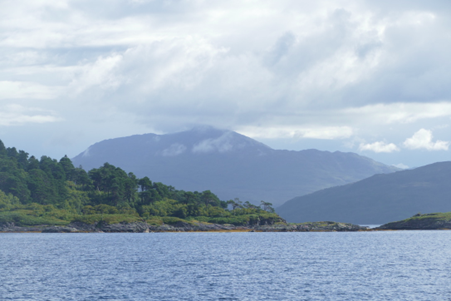
Peaceful anchorage in Loch Stuart
But all this was rudely interrupted when Beverly suffered a nasty fall when the cockpit to galley steps gave way. We put her to bed to see how she would feel in the morning, and the answer was that she needed to be checked out by a doctor. So it was off to Tobermory after all on 5th August, just in time for a miraculously vacant 0930 appointment with the local GP. The diagnosis mercifully revealed nothing which needed treatment beyond careful nursing on board, but lots of bruising and possibly a couple of cracked ribs. She was just able bravely to hobble around very slowly, on board and ashore, and managed to enjoy Tobermory in some rare sunshine, including an early supper at the famous Café Fish on the ferry pier.

Adnamurchan Point Lighthouse
Round Ardnamurchan to Arisaig, Loch Nevis and Loch Hourn
Having a badly bruised patient on board meant avoiding too much motion at sea, and rolling in particular. 6th August started drizzly again, but with only 10-15 kts from the South West. Hugging the Mull shore after an 0630 departure before bearing away for Ardnamurchan Point minimised any rolling, and the rest of the passage to Arisaig was almost a run, with the kindest of motion in the SW swell. Arisaig is one of Beverly’s favourites, particularly the outer reefs where at low tide you can anchor just inside the beautiful rocks and tiny sandy beaches. We arrived when the tide was half-way up at 1000, just as the sun came out. Later we anchored in Stewart’s Bay, out of the wind and swell.
But going ashore was out of the question, so after lunch we pushed on past Mallaig into Loch Nevis (meaning heaven) to pursue again our ambition to go all the way to the top. We were through the narrows by 1700 and anchored at the very head of the loch half an hour later. The passage up the loch towards huge hills with their tops shrouded in cloud was spectacular, but the anchorage at the head was a disappointment. The wind was howling up the upper loch, so we were anchored on a dead lee shore. There was one gloomy empty house to look at, and nothing to assuage the gnawing fear of dragging onto the strand.
So at 1830 we weighed and thrust our way back up to the narrows, then turning to port into the delightful little Tarbet Bay, nicely out of the wind for the night.
Next morning (7th August) revealed the beautiful Danish working gaff cutter Eda Frandsen anchored nearby, with her charter crew enjoying an early swim. To my surprise we were greeted by a stentorian “Michael Briggs” by her skipper, who turned out to be none other than Mungo Watson, who we had introduced to serious sailing as a teenager at the 2003 Fife Regatta in when he literally strode along the pontoon and demanded to go sailing in a Fife. He graduated from Mikado (by then doing Med classic regattas) straight into Adix, and his professional career has gone from strength to strength. He and his partner Stella now own Eda Frandsen and offer charters in the Western Isles and in Cornwall.
As if that wasn’t enough, on the way back down the loch we came across the lovely Fife gaff ketch Kentra, which had been part of the Fife Regatta fleet in June, and turned out to be the only RYS yacht we encountered on the whole cruise.Sadly Ernst and Doris Klaus, her long term owners, weren’t on board, and she was headed South.

The lovely Kentra in Loch Nevis
All that was early in the morning. By 1030 we were entering Loch Hourn (meaning hell) after a short rolly reach from Loch Nevis, passing Doune where Eda Frandsen had been restored.
To get to the top of Loch Hourn you have to pass through no less than four sets of narrows, each narrower and more difficult than the last, with the top set impassable below half tide. But by contrast with the previous day it was well worth it. Having sunshine for most of the morning certainly helped, and we had a peaceful lunch in light wind at the very head of the loch, surrounded by uninhabited, roadless, mountainous wilds. But then the rain set in, with mist and fog threatening to follow, so it was back down the loch and a quick passage over to the Isle Ornsay anchorage on the Skye side of the Sound of Sleat, arriving at 1530 with the viz down to 1/3 mile. Now there are some very good restaurants thereabouts, but Beverly was still too sore for dinghy work, so we just anchored out of the SW swell, to await our tide through Kyle Rhea the next morning, while the writer tried to put together some reasonable substitute for the missed cordon bleu dinner which we might have got ashore.
Motorboat Maudorces Cruise Around Great Britain

Our venerable member Peter Wilson is currently on a cruise around Britain on his Motorboat Maudorces. As the combined ages of the yacht and owner are 180 this is a considerable undertaking. They plan to attend the BCYC Regatta in Cowes in July before finishing back in Suffolk
Currently they are steaming up the North Sea and have reached Scotland, where they say it is surprisingly cold. You can follow their progress on their website followmaud.co.uk
Entry Open for British Classic Week 2022
Founded in 2002 and hosted by the British Classic Yacht Club (BCYC), British Classic Week will celebrate its 20th anniversary from 16th to 23rd July in Cowes this year. Entry is now open for the regatta, which is set to be a celebration of classic yachts on and off the water.

Criteria for entry is IRC classic yachts of 24ft and over or modern classic, Spirit of Tradition yachts of either wood or steel construction. This year, the regatta will host a new class for gaff-rigged yachts to race under the latest OGA ratings. Cruising yachts and classic motor boats are also invited to join British Classic Week to watch the racing, explore local waters and enjoy the social scene.
BCYC Commodore Jonathan Dyke commented, “Pre-entry interest in attending the 20th edition of British Classic Week has been high, and we are anticipating a wide range of classic and modern classic yachts from across the UK and Europe this year. We are looking forward to welcoming everyone to Cowes to celebrate 20 years of classic yacht racing and camaraderie.”
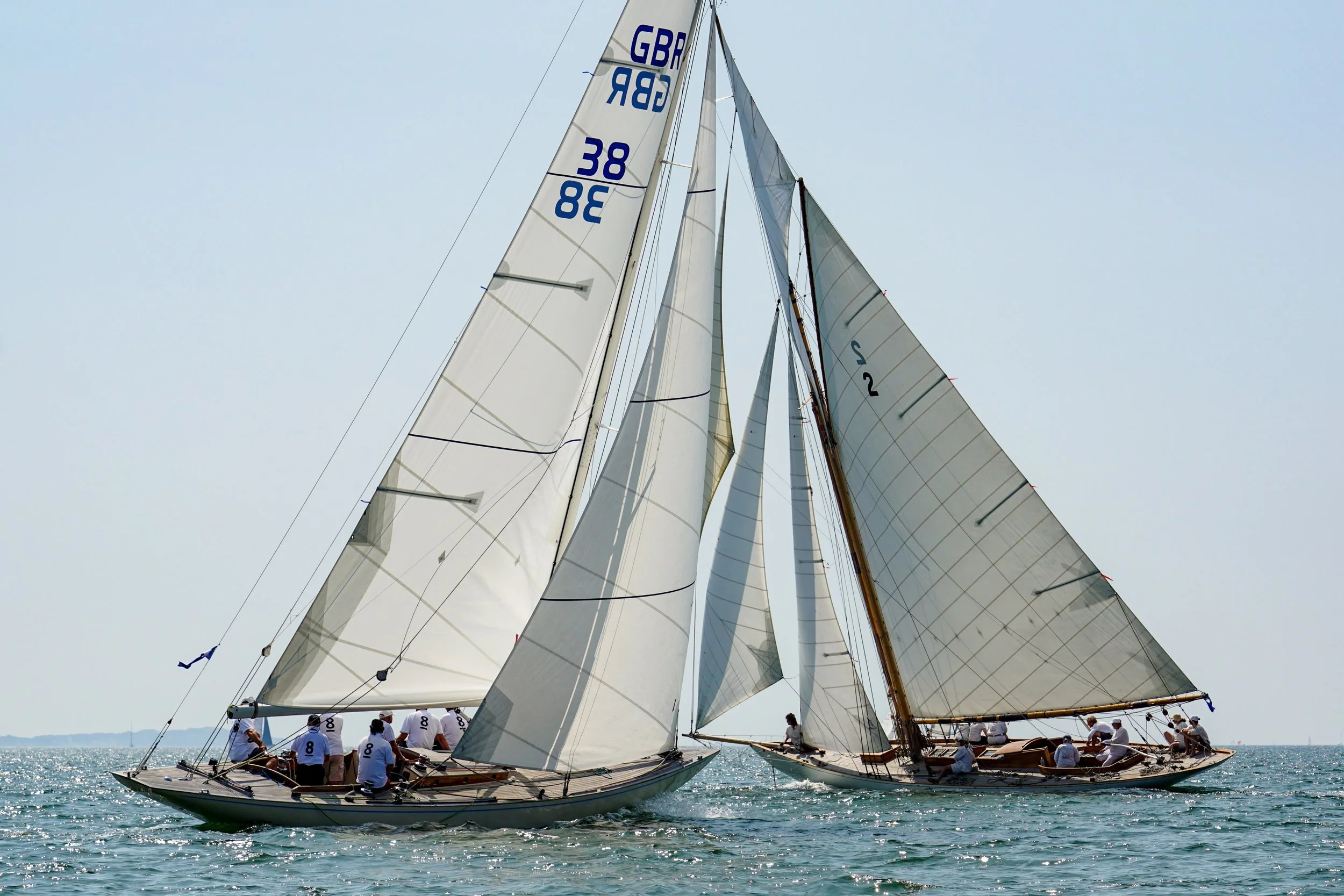
Sailors will take on a six-race series of varied courses, including round-the-cans races and the 30nm Nab Tower Race that takes in the iconic Horse Sand and No Mans Land Forts. Race management organised by the Royal Yacht Squadron will see beautifully maintained classic yachts battle it out against the historic, picturesque backdrop of the Isle of Wight.
Keen spectators will be able to get close to the action on the water and watch line starts and finishes in front of the famous Royal Yacht Squadron.

With drinks brands Adnams, Hattiers Rum and Dartmouth Gin providing celebratory drinks delivered direct to yachts after they have crossed the finish line, the social scene promises to be lively on and off the water.
The social programme includes the traditional welcome reception on the lawn at The Royal Yacht Squadron on Sunday 17th July. On Tuesday 19th July, regatta attendees will have the opportunity to peruse the fleet of timeless classics during the Open Yachts Pontoon Party (sponsored by Classic Boat with drinks by Hattiers Rum and Dartmouth Gin). The regatta will finish with a prize giving dinner on Friday evening

This year’s British Classic Week will see continued sponsorship from OneSails GBR and Spirit Yachts, with event support from Suffolk Yacht Harbour and traditional chandlery Classic Marine. The UK’s leading publication on classic and traditional boats, Classic Boat magazine, remains the regatta’s media partner.
The regatta’s charity partnership with the UK’s oldest and largest youth development sail training charity Tall Ships Youth Trust continues into its second year for 2022. The collaboration raises awareness and funds for the charity’s work helping disadvantaged young people to fulfil their life potential through adventures at sea.
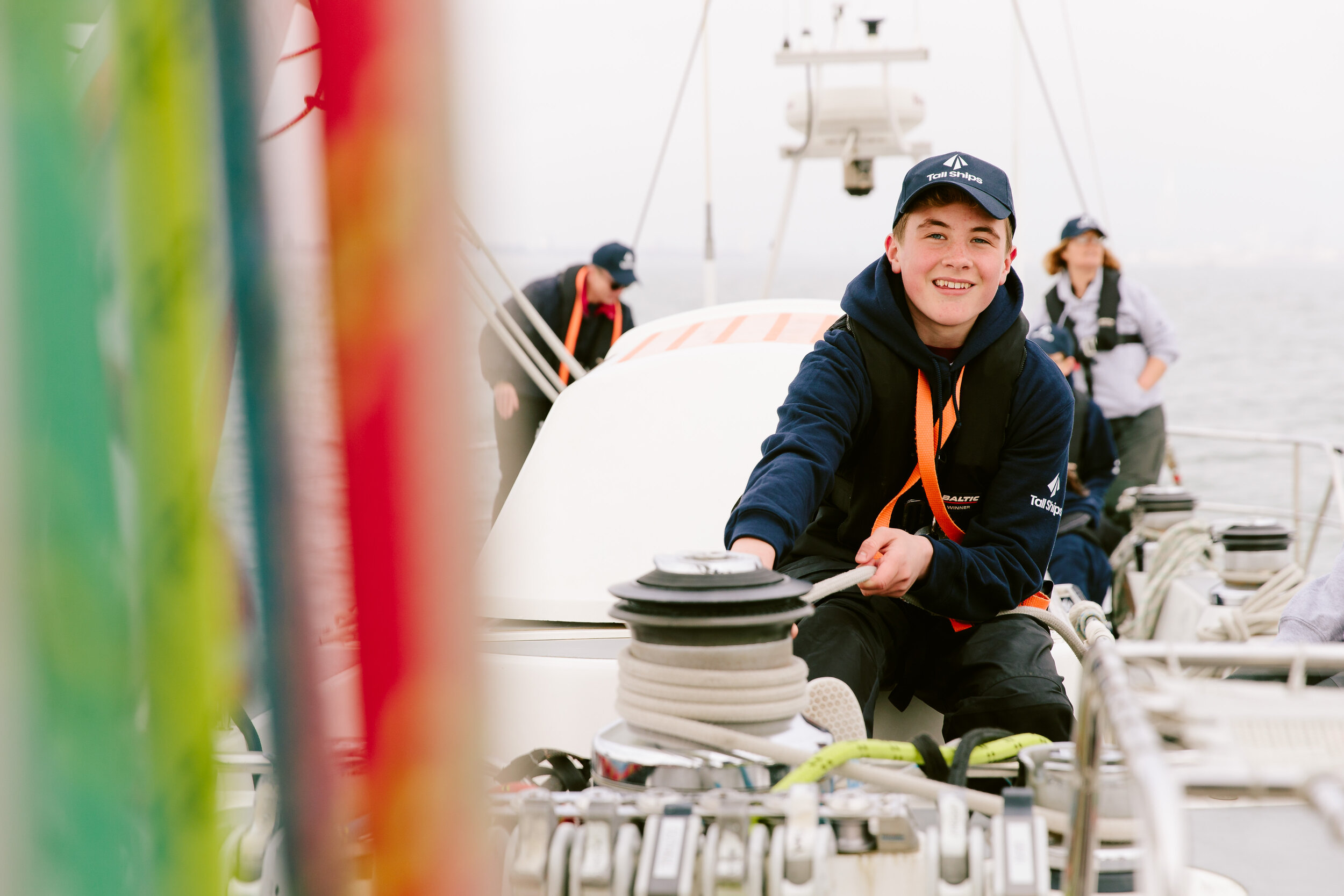
Jonathan Dyke commented, “British Classic Week began in 2002, when a group of like-minded owners started a regatta to celebrate classic yachts and the people who maintain them. Whilst the regatta has evolved, the ethos is the same: quality racing, camaraderie, and a shared appreciation of beautiful classic yachts.”
The motto of the BCYC is Per Ardua ad Marum (Through hard work to the Seas), paying homage to the commitment required to own and maintain a classic yacht. Most of the classic yachts that attend the regatta are privately owned, meaning that for many their upkeep is purely down to the devotion of their owners and crew.
Hon. Secretary's November Newsletter
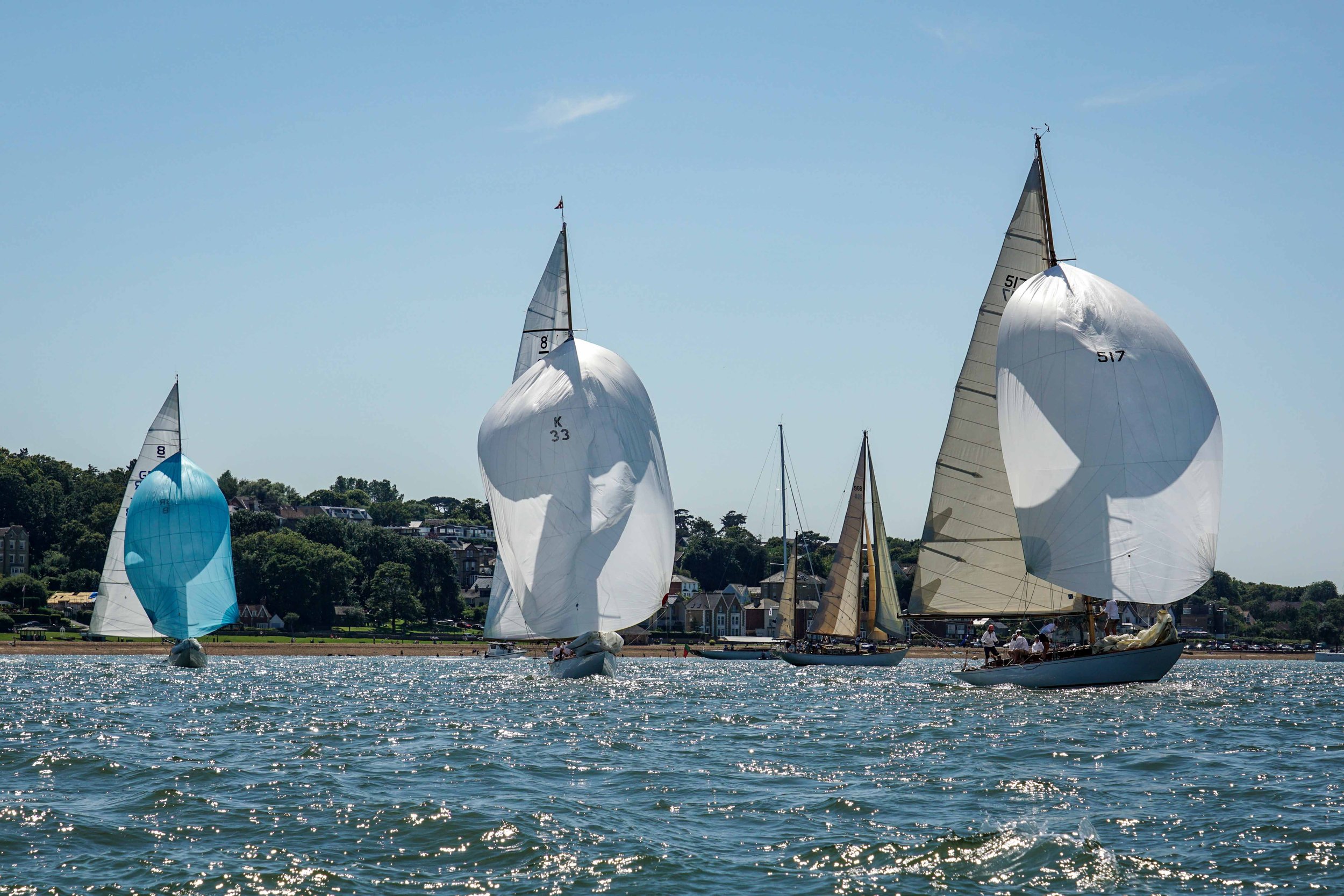
The summer has gone and our thoughts now turn to laying up as the autumn gales start to sweep in. This year we were able to enjoy more freedom to sail, to enjoy time on the water and to meet each other. Our annual regatta, British Classic Week, was run and financially suported by the Club for the first time in many years, without the financial support of Panerai, and it was judged as a success by the almost 50 yachts which attended.
Thanks must go to Mary Scott-Jackson for her cheery and efficient management of the Regatta, to the Royal Yacht Squadron for their superlative race management in minimum wind conditions and to Michael, Lord Briggs,for his chairmanship of the event.
We are fortunate to have ongoing sponsor support from Spirit Yachts, One Sails, Suffolk Yacht Harbour, Classic Marine, Adnams Brewery and Brig Ribs.
The overall winner of the week, and of Class 1, was Baron Laidlaw with Oui Fling who overcame Sean McMillan on Flight of Ufford. In Class 2 Christopher Courage’s 8 Metre Helen just edged out Louise Morton on Lak II by a single point. In Class 3 a very consistent Michael Briggs on Mikado took full advantage of the very light winds, leading Giovanni Belgrano on Whooper home. And in Class 4 Scot Yeates aboard Stiletto celebrated her 60th anniversary by edging out Tim Hannon sailing Peter Wilson’s Kajsa on a count-back tie.
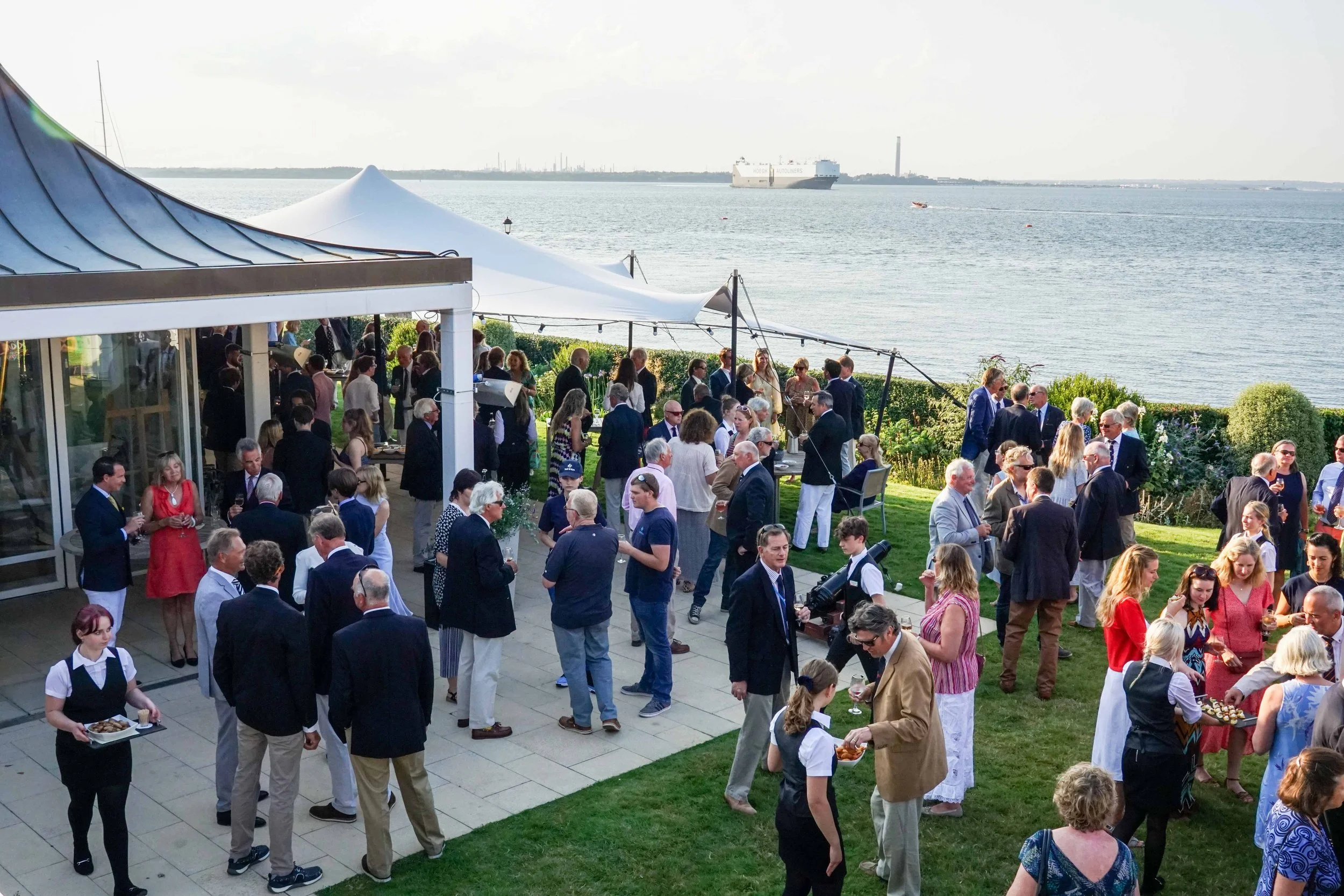
The social side was happily able to take place as Covid retrictions were lifted just as the Regatta began. The Marquee was a popular meeting place and the presence of several lovely vintage motor yachts added a touch of glamour to the Fleet. The evergreen and iconic Kelpie was a stirring sight with her topsails set. The magnificently restored Stormvogel made an appearance before her own anniversary entry for the Fastnet.
Plans are already underway for next year’s 20th Anniversary Regatta and we are developing a suitably exciting programme and a gala birthday dinner for the Autumn.
The newly introduced Cruising Cup was won by Lord Michael Briggs for his account of the voyage of Kingfisher to the Scilly Isles.
Kingfisher Log 2021 by Michael Briggs
Kingfisher goes west

Kingfisher off Great Bay St Martin’s, Isles of Scilly
Introduction
Following a second extensive winter refit, this time at Harbour Marine Services (“HMS”) at Southwold, Kingfisher arrived back at Chichester Harbour in time to do her mother-ship duty at the British Classic Yacht Club Regatta in mid-July, where her charge Mikado won her class. The summer plan was then at least a month’s cruise after a week in Argentario, visiting our son Nick.
With COVID making visits to Europe difficult in yachts, our only real choice was to revisit the South West coast of England, the scene of Kingfisher’s first shakedown cruise in 2019, with lots of favourite ports and rivers, and the Scillies as the goal, weather permitting.
By the end of the first week in August the prevailing SW wind pattern had become firmly established, giving the participants in the Fastnet race a stern start, with winds up to F7 roaring up West Solent and causing lots of retirements.
Sunday 7th August – Chi to Cowes
Not to be outdone by the Fastnet fleet we left Northney at 10.15 bound for Cowes, with a plan to spend two nights at the RYS Haven. As luck would have it, the Castle was unusually closed, to clean up and recover from Cowes Week, but the Haven was therefore peaceful, with only two other yachts present. The passage there was dead upwind into 25kts plus, as always roughest of all at Chi Harbour entrance, giving Kingfisher a welcome opportunity to demonstrate her excellent seakeeping, and us a chance to see that all last year’s leaks around the wheelhouse windows and Clearview screen had been fixed during the winter refit. Well, they had, almost, and a little further treatment from Captain Tolley meant that they gave us no more trouble.
A brisk passage at a prudently modest 6.5 kts brought us to Osborne Bay in time for lunch, and we were safely in the RYS Haven by teatime, followed by evening drinks with Richard Crowder in his fabulous state of the art modern motor yacht, complete with omni-directional screws and the ability to lie geo-stationary at the touch of a button.
A nice hot Charlie Brigham fish pie rounded off the day. We’re still rejoicing in having our first boat with an oven.
Monday 8th August – Alongside at Cowes
Exceptionally heavy overnight rain was followed by a nice sunny day in Cowes, where we were visited by our niece-in-law Margaret and her twin girls for lunch, paying their first visit to Cowes and bringing some newly covered deck cushions which hadn’t been ready when we left. Then Johnny Clark and Liz Jones drove over from Ryde for dinner on board.
Tuesday 10th August – Cowes to Weymouth
This was our real start day, and the wind had kindly moderated to a comfortable 10-15 kts, but still South-West, dead on the nose. We wanted to get to Weymouth as our jumping-off point for West Bay. So, to get there in a single tide, we started at 09.15 dodging the east-going stream by staying very close inshore, reaching the Needles at slack water by 11.15, with a fair tide from then all the way.
With wind over-tide it was quite bouncy through the St Albans race at 14.00, but nothing like as wet as it would have been beating through in Mikado. By then we had our new steadying sail up, which kept us from rolling as we bore away onto a port tack fetch for Weymouth, coming alongside at 15.45.
Alongside meant rafted up on a modern 48ft power boat, making it very hard getting across her high superstructure to the dock. Close astern was the lovely, fast, famous, Le Havre pilot cutter Jolie Brise.
Soon afterwards we were joined by David Murrin and Sarah in Cetewayo, a fellow competitor in the BCYC Regatta, who had also sailed up from Cowes, getting seriously wet in the St Albans race.
Rosie (the skipper’s step-mum) and John and Maggie Ungley joined us for dinner on board, followed by the Cetewayo team for red wine and cheese. By then we had dropped back alongside her, to make it easier for our dinner guests to get ashore.

Kingfisher alongside Cetewayo at Weymouth
After fuelling from a bowser lorry on the dockside (a very useful and friendly service at Weymouth) we left for our trip across West Bay at 11.45, planning to take the South-going eddy along Portland, and arrive at the Bill at slack water, which we duly did, at 12.50. Cetewayo had planned to cruise west with us in company, leaving Weymouth at the same time, but we saw no more of her.

Rounding Portland Bill
The wind was SW by S, about 12kts, just free enough for our steadying sail to keep us from rolling over the large SW swell. A pretty uneventful passage, apart from the usual welcome committee of friendly dolphins as we neared Dartmouth, entering harbour at 18.15, after carrying a fair tide the whole way across West Bay, save from the last couple of miles.

Kingfisher entering Dartmouth
At the entrance we met Peter Gregson (of Wooden Ships) with his sons Richard and Marcus, sailing a beautiful clinker traditional Folkboat, reminding us of our trip through the Stockholm Archipelago in a very similar boat. We had bought Mikado through Peter in the late 1990s, and he has been a constant wise advisor and good friend ever since.
They joined us on board for drinks on the visitors’ pontoon in Dartmouth as the evening mist and drizzle descended. Much chat about how the younger generation (including our son James) are snapping up classic boats, keeping the wooden tradition alive and well. James has just bought Surian, a beautiful Buchanan Sea Spray: 27ft’s worth of perfect last generation wooden yacht building, complete with mirror smooth topsides, perfect teak deck, hot and cold running water, radar, plotter, autopilot, asymmetric etc. etc. Wooden Ships were, just as for us, his entry into the classic yacht scene.
Thursday 12th August – Dartmouth to Falmouth
We thought we would keep up the momentum towards the Scillies by our longest hop thus far, missing out on the pleasures of Salcombe, Plymouth and Fowey, and pushing straight on to Falmouth, despite the continuing headwinds.
It was a misty, almost foggy start, with the radar switched on.
Again, we took the first of the South-going eddy towards Start Point, leaving at 09.50 and arriving there just as the tide turned an hour later, but before the wind against tide overfalls had time to build up.
A bit more wind, at SW 16-23 kts, but the sun came out mid-afternoon as the wind eased.More dolphins came to say hello, as well as a fishery protection boat.We also had our closest run past the Eddystone, so often missed when cruising closer inshore.

The Eddystone Lighthouse
Another quite uneventful upwind day, ending at Port Pendennis at 18.45, just in time before the dockmaster went home for the evening.
For us it was a fish dinner in what used to be Rick Stein’s fish restaurant, now converted to an eater/party venue with (thank goodness) one available table for two. The staycation effect makes finding somewhere nice to eat without booking ahead very hard this summer.
Friday 13th August – a day in the Fal
Not an auspicious day for going to sea, so we decided to stay in the Falmouth area. With 20 kts plus of wind from the South-West, heading round the Lizard wouldn’t have been comfortable anyway.
After refuelling we went up-river to see what Kingfisher’s previous owner’s new boat (his second since parting with her) looked like, on Kingfisher’s old mooring off the Greenbank Hotel. He now has a Grand Banks motor yacht. Looks very comfortable, and we may be biased but we think Kingfisher is (much) prettier.

Anchored off Trelissick
Then up the Carrick Roads to our favourite anchorage off Trelissick House, just to the SW of the shallow bay in front of the house, well sheltered from prevailing winds, and quite deep close inshore. There is a view right down the estuary, and it’s a perfect viewing point for vessels coming up and down river, just where it narrows. There we waited to be joined by our (almost) sister ship Chinda. She came past at 17.30, and we followed in line astern up-river to tie up either side of a detached pontoon at Tregothnan, for a peaceful evening together.

Two sisters, Chinda and Kingfisher
Chinda is a 46ft ‘stretched’ Silver Leaf, not built in the Clyde, but on the Swale in 1946. She must be one of the first motor yachts of any size built in the UK after the war. Also restored at Southwold by HMS. She has the more typical galley and saloon forward, stateroom aft, layout. Apart from her bigger size, the real practical difference between us is that Chinda has her main steering position outside, with all the navionics etc. and only a wheel in the wheelhouse. So, although her Southern ancestry makes her feel slightly less spartan (or Scottish Presbyterian) than Kingfisher, open sea passages call for a tougher kind of owner, being out in the wind and spray when on watch.
Nothing like that this evening, however. We had a lovely fish dinner with her owners Nic and Bertie Seal on Chinda’s quarterdeck, with not even enough wind to cause goosebumps. Then we retired to Kingfisher’ saloon where we made, in Nic’s words the next morning, a ‘wee dent’ in the malt whisky.
Saturday 14th August – Falmouth to Newlyn
Time to be heading West again. The day started showery, but the forecast was for lighter winds from the South, just for once not on the nose, once round the Lizard.
We planned to go to Newlyn, as the best jumping-off point for the Scillies, and in company with Thalia, the wonderful 1888 gaff cutter built by Wanhill of Poole and now owned by David Aisher. His wife Kristi now has another Silver, Cerveza, which she snapped up after spending a weekend in Kingfisher in late 2019.

Thalia
So we joined up with Thalia back in Falmouth harbour, and both headed West, rounding the Manacles at 10.45, followed by a slightly bumpy rounding of the Lizard, just as the tide started to go West, at mid-day. The thing to do in Silvers in a bumpy sea is just to slow down a bit. Their excellent seakeeping qualities going upwind soon enable you to find a (still respectable) speed which avoids any slamming, even if spray continues to come over in buckets. Unlike Portland, there is no way inside the overfalls at the Lizard, but staying well in, just off the rocky shallows, keeps the rough bit to a minimum.
We were in Newlyn by 14.15, well ahead of Thalia, to be directed into a berth between two fishing boats. Newlyn is a busy fishing harbour, with only a little space for yachts. Thalia had to go on the wall, rafted alongside the local fishery protection vessel. But the harbour master is very welcoming, there are good marina-like pontoons and fingers, and the fish restaurants ashore are simply splendid.
We spent the afternoon visiting good friends Shona and Carla who have moved to a beautiful secluded valley between Newlyn and Penzance, followed by a convivial fish supper with our friends and Thalia’s crew at the Mackerel Sky seafood bar.
Sunday 15th August – alongside at Newlyn
We spent the day at Newlyn.

Sunday lunch in the showers at Newlyn
After a truly excellent lunch (same team) at the newly opened Argoe fish restaurant overlooking the harbour, sitting outside with only one rain shower, the skippers of Kingfisher and Thalia walked it off by an afternoon hike to Mousehole, along the coast, and back by a hilly inland route.
Our real purpose was to try and get a look at a big disused quarry South of Newlyn, which might become a new marina (rather like Beaucette in Guernsey) if someone can summon up the energy to blow up the intervening land, including the coast road.
Nothing doing. The quarry was too heavily fenced off to be seen. But we did stop to remember the brave Penlee lifeboat crew at the memorial on the coast road, and for the inevitable ice cream at Mousehole.
Monday 16th August – to the Scillies at last
The endless succession of SW winds was forecast to be interrupted by a brief NW veer, so it was time to get to our main destination.
We proceeded from Newlyn at a stately 6.25 kts to keep company with Thalia motor-sailing under easy sail. We passed Land’s End by 10.35, with 15 kts of NW sufficiently on our beam to call for the steadying sail. An uneventful passage (with few boats around) led us to Porthcressa on St Mary’s by 14.55.
Porthcressa is a very nice anchorage, right next to the fleshpots of the main town, and better protected from swell than the cramped visitors’ moorings in the main harbour, at least in prevailing winds, and particularly in a North Westerly. But we soon appreciated how the pandemic had concentrated yachts on the English coasts. Normally Porthcressa might have about half a dozen boats, well spread out. But this time there were more than twenty. We were to find most of the Scilly anchorages much busier than usual, in some cases making it really quite hard to find swinging room if anchoring (which we generally prefer to mooring).
Our anchorage was also only a short row, then walk, to our dinner date with sister Charlotte, her husband Shaun and daughter Olivia. They holiday every year in the Scillies, getting around the islands bravely in an inflatable kayak. We had a luxury evening at St Mary’s Hall Hotel, by the parish church, where they do a really delicious local caught lobster thermidor.

Lobster Thermidor at St Mary’s Hall Hotel
Tuesday 17th August – living it up at St Agnes

The Cove, St Agnes
Between St Agnes and tiny Gugh there is a narrow inlet called the Cove, with a sandbar at its head connecting the two islands at almost all states of tide. Any wind between North-East, through South to West brings in a swell which can make it rolly, but today, with a North-West breeze, was ideal.
So off we went at 10.30, on the short hop over from Porthcressa, followed by Thalia, into another very crowded but unusually smooth anchorage.
After early lunch aboard it was ashore to explore the island, the highlights being home-made ice creams at Troytown farm, cream tea at the Coastguard café, finishing with drinks on Thalia, where we also met Johnny Goodwin and his family (chartering Richard Matthews’ magnificent Oyster 85 Midnight), James and Sam Ansell and (back on Kingfisher) Noel and Heike Peck, friends of our predecessor owner of Mikado, Chris Cracknell.
Even adding a quick trip around Gugh, the exercise didn’t begin to make up for all the cholesterol and other goodies.
The highlight of the day was being there to witness an extraordinary encounter with a friendly (but probably very lonely) dolphin. His main nickname seems to be Nick, because of all the dents in his skin where he has come into contact with propellers and other yacht extremities. Some call him Randy. No relation of the infamous Wally the Walrus which had recently been causing mayhem in the islands, but determined to make friends with any swimmer prepared to have a close encounter. Emily Harris from Thalia was one of those who jumped in to do just that, while others looked on spellbound in dinghies and from paddleboards.
Wednesday 18th August – exploring eastwards
The continuing NW wind made it an ideal day to explore the Eastern Isles.
But first we took up the offer to visit the magnificent and completely unaltered 1939 motor lifeboat Michael Stephens anchored at the head of the Cove. She is a Dunkirk Little Ship, built by Samuel White’s in Cowes, completely original on deck, in the deep sheltered cockpit and in the engine room, even with funnel and grab lines, but now cruised by Charles and Elizabeth Cave. She was the Lowestoft lifeboat for 24 years. Coffee and biscuits in the cockpit was a delightful trip back in time.

The Michael Stephens
After Thalia cleared a foul anchor it was off at 11.00 for the Gantillies, for a ‘bubbly’ long lunch at anchor in the shelter of Ragged Island. The bubbles were meant to celebrate Emily’s birthday, but she then had to confess that she was a day ahead of herself!
We thought that the NW wind would be good for exploring the outside of St Martin’s, where there are a series of sandy bays with off-lying islets and rocks giving some protection from the swell. But not much as it turned out. Somehow the NW swell works its way round the top of St Martin’s, making the bays too rolly for comfort. So, on we went, round the top of St Martin’s to an anchor in Tean Sound, to the south of the moorings, out of the swell and out of the worst of the strong tidal current there. On the way we did a full power run past Thalia for a photo-shoot by Emily, who later provided the lovely picture of Kingfisher at the beginning of this log.
Thalia anchored nearby, for her last evening in the Scillies before sailing home while the Westerlies lasted.We all went ashore for drinks with James Trafford, in his family cottage in Higher Town, before supper at the Seven Stones. James ferried us around in his elderly mini-hatchback. At one point we squeezed no less than seven of us inside, including Emily and co-crew Hannah in the boot.
Thursday 19th August – New Grimsby and Bryher
Stores were beginning to get a bit low, so it was off early, past Round Island to New Grimsby sound, between Tresco and Bryher, for shopping at the excellent and well-stocked supermarket in New Grimsby. After lunch back on board it was time for a good walk around Bryher, as a showery morning gave way to a sunny afternoon. Although Tresco and Bryher are close to each other, they could not be more different. Tresco is a sophisticated, well-run holiday island, with every amenity, wonderful botanical gardens and electric buses with comic names like Boris and Maggie. Bryher remains the little island at the edge of the world, with no traffic, lovely sandy bays mixed with wild rocky coast on the Western side, and nothing modern apart from the Hell Bay Hotel, where we had a rather solitary afternoon tea.
Rather more fun is Island Fish, the fresh fish shop-cum-café near the ferry landing opposite Tresco. Every Thursday they do a mountain of take-away seafood paella. Alas, we were not free to collect at the appointed time, but settled for their equally good fish pies, to be warmed up in the oven later in the evening.
The reason we had to miss the paella was an invitation to evening drinks from Calum and Amanda Sillars (RYS) in Rinamara (Gaelic for Queen of the Sea). She is one of the justly famous McGruer 47ft yawls, built right at the end of the period of wooden boatbuilding. Rinamara had just been extensively and beautifully refitted by Stirlings at the historic no.1 Slip in Plymouth, about a year after Kingfisher received similar treatment for us in 2019/20. Like Thalia, she was getting ready for an early departure back to the mainland the following morning, before the long-established Westerlies finally gave out. She really is the last word in comfortable, good performance, wooden cruising boats. Whatever their modern technology, it is very hard to find anything built later in GRP with a better combination of good looks, comfort at sea and performance under sail.
Friday 20th August- Samson
Samson, and its small anchorage just off the sandy beach on its East side, is high on our list of favourite spots in the Scillies. The island is uninhabited, but with extensive ruins to explore from many centuries’ habitation by rugged, self-sufficient islanders. The anchorage off the beach, between Bar Point and Puffin Island, is almost empty once the day-tripper boats have gone, mainly because of the shallow depth at low tide. The beach is perfect for bathing, and there is shelter from almost all wind directions, provided you anchor well in.
The Samson anchorage is in plain sight from New Grimsby, but getting there from New Grimsby harbour at low tide (which it was) involves a long detour round the top of Bryher, across the aptly named Hell Bay and round the many rocks and islets on its West side. We threaded our way inside Scilly Rock, round Black Rocks and then between Castle Rock and Illiswilgig, coming to our anchor fully sheltered from the SW wind at 10.30.
After our walk mainly through breast-high bracken, alone apart from one other group, the tide was still quite low, so we continued West about, round the rocky back of Samson, outside the Minalto rocks and ledges, before turning East to look for somewhere to go swimming. Bar Point on St Mary’s looked good, since the sandy spit sticks out northwards and cuts off the last of the Westerly swell. All looked good as we anchored, but then drizzle set in and spoilt our plans.
We thought we would have another go at the North-East (outside) of St Martin’s, so we threaded our way through the Eastern Isles again, coming to anchor in Bread and Cheese Cove, a deep inlet just past the daymark at the South-East end of St Martin’s. We shared this small anchorage with only one other boat and spent a peaceful night in what proved to be the last rain of the whole cruise. Bread and Cheese Cove doesn’t have the grand sandy beaches found elsewhere on the back of St Martin’s, but it is deep and quite dramatic, with steep cliffs on both sides and a tiny rocky beach at the head of the cove, with a steep path up to the daymark. Well worth a visit, and a safe night’s stay in Westerly winds.
Saturday 21st August – Boat trip for Charlotte
This was the day we’d set aside to take sister Charlotte and her family boating. By this time they had moved to a picturesque cottage in Higher Town on St Martin’s, right opposite the bakery, so a pick-up in Great Bay required them to take only a short walk, bringing us some shopping, before a dinghy ride out to Kingfisher, which had moved round one bay to collect them.
The plan was to take them to places where they couldn’t go in their kayak. After welcome coffee during a sharp shower it was round the top of St Martin’s again, seal watching off Great Merrick Ledge, before anchoring in Porth Morran, a long inlet between rocky ledges right at the North end, offering very good shelter in winds with any South element, although the inner part of the inlet is rather choked with weed.

Seal watching off St Martin’s
The weather obliged, just in time, with an early shower giving way to wall to wall sunshine, which was to last for most of the rest of our stay in the Scillies, after a rather grey first week.
After more coffee we continued West, inside Round Island, for a good explore of Hell Bay and its blue jelly- fish, past Castle Rock again and into our favourite Samson anchorage in time for lunch.

Happy beachers at Samson
The afternoon was spent swimming and shell hunting on the sunny beach during the rising tide, where we were joined by a small army (or perhaps large fleet) of kayakers.
We’d all booked into the famous Adams family fish and chippie on St Martin’s for supper, so we were back at anchor in Great Bay for a run ashore by 17.30. The Adams family doesn’t just run a chippie. They catch the fish and grow the potatoes as well.
The washing machine in Charlotte’s cottage worked hard while we were at supper, and it was a glorious sunset by the time we began our walk back to Great Bay in the evening

Great bay, St Martin’s in the gloaming
Sunday 22nd August – St Helens Pool
Great Bay gave us a rather rolly night, perhaps because of a veer in the wind. So we left at 06.00 and moved round to a guaranteed placid anchorage in St Helen’s Pool, between St Martin’s and Tresco. It deserves its reputation as the best anchorage in the Scillies, protected by Tresco in the West, St Martin and Tean in the East, St Helen’s (the quarantine island) in the North and extensive shallows in the South. The day was spent quietly, walking on Tean in the morning, and rowing round Crow’s Island watching the many oyster catchers in the afternoon.
Monday 23rd August – the NE wind starts
We woke up in flat calm to find that Sybil of Cumae had come in to St Helen’s Pool during the night, on her way back from Milford Haven to Plymouth. I’m afraid to have to report that in our eagerness to see her owner Cornelius van Rijckevorsel we woke them up from a well-deserved sleep. But they seemed very good-tempered about it once they saw who it was.

Sybil of Cumae
Sybil is a 1903 one-off Fife cutter, in effect a big sister of Mikado. Glorious Fife sheer line and very low freeboard, with a metal mast painted to look like wood (and therefore called Mt Edgecumbe pine). She sails like a witch, and we were anxious to ensure that she was going to enter for the 2022 Fife Regatta in the Clyde, which she has thus far never attended.
Leaving her crew to return to their bunks we left at 07.15 for another visit to the Cove at St Agnes, since the very calm weather promised freedom from the usual swell.
Our purpose this time was to find and explore Beady Pool on the South side of St Agnes, where there are reputed to be a hoard of glass beads from a long-vanished wreck. With the assistance of Google Maps we found the pool, but sadly no beads.
So it was up the hill for lunch at the nearby Coastguard café, followed by swimming off our newly acquired swimming ladder in the Cove.
With a North Easterly wind just starting (with risk of swell overnight) we decided to head for St Mary’s harbour for the night, arriving in time to be part of the welcoming party for the transatlantic rower Ian Rivers in his boat Sentinel, who had been forced to row the last few miles to St Mary against the wind and tide. How a single oarsman makes real progress in such conditions in a large transatlantic self-righting boat passes my comprehension. It reinforces the wisdom of the old adage that if God had intended us to row He would never have given us the wind.

Sentinel, just arrived from across the pond
St Mary’s is not one of our favourite anchorages. The visitors’ buoys are largely outside the protection of the harbour wall, and amazingly close together for the size of boat they claim to accommodate. They are not very close to the town (certainly no closer than the anchorage at Porthcressa on the other side of the town), and East to South is the only wind direction where the anchorage is really swell-free. And it was very crowded, with only one or two free moorings.
Tuesday 24th August – Herbie the duck
The morning was spent fuelling, watering and shopping in St Mary’s. By this time the East wind had become well established, at 20 kts, and was (unknown to us at that stage) to persist for almost the whole of the rest of the cruise, a duration for an Easterly which I have never previously encountered in the summer. At that stage we fondly thought it couldn’t last for more than a few days, before the prevailing Westerlies resumed to blow us comfortably home. How wrong we were!
Low tide (springs) was at 13.30 so we went only as far as our favourite anchorage off Samson for lunch, waiting for the young flood to cross the shallows back to New Grimsby for the evening, where we anchored off the quay at 16.40, in preparation for entertaining James and Fiona Holman to dinner on board. They have an annual timeshare on Tresco, and no summer visit to the Scillies is complete without our meeting up.
Next to us was a yellow Prout 31ft catamaran called Luna with mum and dad and a young family aboard plus, astonishingly, a resident duck called Herbie.He lived on board, flying off each day for a bit of exercise but always returning faithfully home for the evening.I’ve heard of ships’ cats, dogs and even rats, but a duck????

Herbie the duck
We duly picked up James and Fiona off the quay at 19.00 and anchored for dinner just under Cromwell’s Castle, which commands the narrow entrance to New Grimsby harbour, and was built to put a final end to Royalist privateering from the Scillies during the Civil War.

Cromwell’s Castle, Tresco
Wednesday 25th August - Cathy arrives

Cathy
Today we were due to be joined by our good friend Cathy (the mother of our friends in Newlyn) for a few days, who was coming over to the Islands in Scillonian. We duly picked her up from the very end of the main quay at St Mary’s at 12.45 before taking advantage of the continuing Easterly to explore the usually forbidden West coast of Bryher, coming to a sheltered anchor for lunch just outside the grandly but misleadingly named Great Porth, overlooked by the Hell Bay Hotel, which isn’t in Hell Bay at all. This area is usually inaccessible to visiting yachts due to the prevailing swell from the West, but the combination of a low spring tide (exposing rocky ledges on all sides) and the East wind, now down to 12 kts, made it an idyllic day-time anchorage, though not a place to stay overnight.
Beverly and Cathy fancied a walk back across Bryher, so the skipper took them ashore in the tender and then single-handed around the top of Bryher to New Grimsby harbour to pick them up.
We had been invited by Andy Bristow for drinks aboard David and Kate Kenyon’s lovely Italian-built motor yacht Back Soon, anchored off Hangman’s Rock, where we were joined on board by James Trafford and his parents. What a contrast with Kingfisher! No hint of the presbytery. Just unashamed luxury, waiter service from her young paid crew, deck chairs, acres of white paint and teak decks. ‘Just sublime’, as Para Handy would say.
Thursday 26th August
With wall-to-wall sunshine setting in under a welcome anticyclone (not shared by most of England) we decided to stay in New Grimsby, to swim, to ‘do’ the Tresco botanical gardens and this time to get our share of the Thursday seafood Paella being served up by the Bryher fish café.
The gardens continue to be a surprise and delight every time we visit them. Too big to be crowded (even though now a cruise ship destination), immaculately maintained and with a wealth of flora not viable on most of the mainland, they really are a must-see for anyone cruising to the Scillies. There are even red squirrels and a brightly coloured family of quite tame golden pheasants.
Tame Golden Pheasant at Tresco Gardens
On return we found we had anchored a bit too near the Bryher side of the shallow end of the harbour, the first time we have ever grounded Kingfisher, but only very slightly, on a soft sand bottom. A 50 yd move East after low water secured sufficient swinging room for the night, and the peaceful demolition of the paella, which fully lived up to expectations.
Friday 27th August – Old Grimsby
A calm and sunny day was ideal for an expedition to the Eastern Isles, where we anchored for breakfast between Great and Little Gantilly, before heading back across the flats to an anchor off the Blockhouse Fort just south of Old Grimsby harbour, on the east side of Tresco. The Blockhouse is an old gun battery which performed the same function at Old Grimsby which Cromwell’s Castle did at New Grimsby.

The Blockhouse, Old Grimsby, Tresco
Charlotte, Shaun and Olivia kayaked over the flats from St Martin’s, and we all went to lunch at the Ruin, the excellent beach restaurant on the other side of the harbour. Seafood platter and crab linguine were the order of the day.

The Ruin beach café, Old Grimsby, Tresco
After exploring the Blockhouse and the nearby beaches, we said a temporary goodbye to Charlotte and family, in time to welcome Jenny and Max Thorneycroft on board for early evening drinks. They were also time-sharing on Tresco and en route to the Ruin for dinner.
Saturday 29th August – Annet and a birthday for Charlotte
This was to be our last day in the Scillies, even though the East wind showed no sign of coming to an end. The complete absence of any Westerly swell made it possible to explore another area usually forbidden to yachts, namely Annet and the West side of St Agnes. Annet is a bird reserve from which all humans are excluded, and its shores, especially to the West, are peppered with rocks and shoals, not all completely charted. On the West side of St Agnes there is a little drying harbour called Periglis, with a few local fishing boats in residence, into which we poked our nose, but without stopping since the tide was falling.

Off Periglis, St Agnes
Today was Charlotte’s birthday so, before the tide got too low over the flats, we high-tailed it back to the anchorage South of Tean, by 11.05. The afternoon was spent walking round the North side of St Martin’s, an expedition made rather longer than expected by the need to walk down most of the North-East side before finding a path back across the middle. Bev and Cathy cooled down with a quick swim.
Then it was birthday champagne on the beach, followed by birthday dinner at the Karma Hotel, and back to the boat in the dark.

Birthday Champagne on the beach, Tean Sound, St Martin’s
Sunday 30th August – back to the mainland
Anxious study of the Almanack and tidal-stream atlases on Saturday evening suggested a very early departure the following morning. The plan was to avoid reaching the Lizard with a full East-going tide pushing against the continuing Easterly wind. So at 05.00 we crept up Tean Sound in the misty darkness, which turned into a sunny morning with 10 kts of wind from the North East, nearly on the nose but not enough to kick up an uncomfortable sea.

Wolf Rock
Our direct route to the Lizard took us 1.5 miles off Wolf Rock by 08.00, and we crossed courses with Scillonian (on her way out) by 09.30. The wind slowly veered round to South-East and dropped a bit, falling to a calm by the time we reached the Lizard at 11.00.
Turning into the mouth of the Helford at 12.40 we met up with another Silver Leaf, Silver Crescent, off Gillan Creek, before anchoring off Greg Powlesland’s slip at Tremerlin at 13.15.
Greg and his son Rupert (part of Mikado’s crew) were at the Durgan Regatta down-stream, but Greg joined us for drinks at 18.00, sailing up in his delightful 18ft lug-rigged skiff.

Greg Powlesland in his skiff
Then we moved up to our favourite anchorage off Tremayne Quay for a peaceful night among the owls.

At peace off Tremayne Quay, Helford River
Monday 3rd August. – a peaceful day in the Helford
Cathy was due to leave us that morning, so she went ashore at Tremerlin, after which the lure of a day in peace at Tremayne proved irresistible.
Helford River is a beautiful place, in three quite different parts. First (coming in) there are the lovely wide expanses and little bays of the outer entrance, but these were susceptible to the Easterly swell. Then there is the central part near the village and Porth Navas, but it’s choked with moored boats. Finally there is the utterly peaceful upper part, all the way to Gweek Quay, but most of it dries out, and the lower part is (or used to be) encumbered with oyster beds.
But for us, Tremayne Quay hits the spot. It’s as far up the Helford as you can remain afloat at low tide, provided you anchor in the little deep pool opposite the quay. There are wonderful woods surrounding the quay, looked after by the National Trust, where you can walk for hours undisturbed by anything mechanical. We shared the anchorage with a little Morecombe Bay prawner, almost out of sight of the big gaggle of moored yachts in Helford narrows over a mile downstream. An extraordinary contrast with the Scillies, but both places teeming with wildlife and exuding natural peace and quiet to calm the soul.
During the morning the skipper sought to work off some of the consequences of good living by rowing back to, and up, Frenchman’s Creek, where there is an interesting wreck at the entrance, a dinghy landing half-way up, and otherwise nothing apart from tranquillity and the recollection of a famous novel.

Frenchmans’ Creek
The afternoon was taken up with walking from Tremayne Quay, where it’s just possible to row ashore even at low tide, without getting too muddy.
Tuesday 31st August – Pendennis and Polynesia
When I was a kid my Dad bought Laa Mao Mao, a one year old 27ft polynesian catamaran , beautifully home-built to plans designed by James Wharram. She was like a great big plywood Hobie cat (although those did not exist then) with a slatted deck, flexible cross beams and tiny bunk cabins in each hull. After we doubled her sail area she went like a rocket, offshore passages averaging 10 to 12.5 knots being commonplace, though in the days before drysuits you had to wear 2 sets of oilskins, one inside the other, to stay dry. And she only drew 1 ft 6ins, with no need even for daggerboards, so you could cruise literally anywhere, including anchoring once in the tarmac’d car park at Mont St Michel. We got to know James Wharram and his family very well, so we always make a point of trying to see them when we are cruising West, though even Kingfisher can’t make it up to their peaceful creek-side home at Devoran, preferring the pier at the Pandora Inn if the tide serves.
Well, it didn’t, so we had them on board for dinner at the Pendennis marina, after an early trip across from Helford to Falmouth, and a lazy day’s shopping, during which I picked up a book of Ed Burnett’s wonderful designs at the excellent second-hand bookshop in the High Street.
James is in his 90‘s now but he and his design partner Hanneke Boon are still seriously active, designing, writing and sailing their lovely 63 ft Pahi catamaran Spirit of Gaia, now based in the Aegean, for up to 3 months every year. James gave us a copy of his latest book, The Sea People, and we had a memorable evening reminiscing about more or less piratical exploits in the past. They seem to have forgiven me for abandoning multihulls for monohulls, and then getting a motor yacht. James is perhaps uniquely knowledgeable among the great living boat designers and had some serious insights to offer even about the design heritage behind Kingfisher and the Silvers, reckoning that they were developed from early working motor launches.
Wednesday 1st September – Fowey
A serious punch into lots of easterly wind, leaving Falmouth at 09.20, brought us round the Dodman (well offshore) to Fowey by 13.30, securing to one of the detached pontoons opposite the lifeboat station, beautifully sheltered from the wind, and within a stone’s throw of the dinghy jetty.
If we had to choose a single traditional harbour as our favourite, I think it would be Fowey. More intimate than Dartmouth, less congested on the water than Salcombe, with its own classes of classic dayboats to watch racing, two friendly yacht clubs, good shops and eateries and the most picturesque waterfront buildings. And it’s still a serious commercial port, with quite big coasters regularly feeling their way through the harbour to the clay loading piers up-stream.

Big ship in little Fowey
The arrival of September seemed to produce an immediate reduction in the number of visiting cruising yachts, so we had lots of space on the pontoon. Even the tourists on staycation ashore seemed to be thinning a bit, although the weather remained superb.
As luck would have it our good friend Robert Owen was at home at his waterside cottage, so he came aboard for a leisurely dinner, to round off a delightful day. We also a chance to return hospitality to the Kate and David of Back Soon, Fowey being their home port.
Thursday 2nd September – more Fowey
The nice thing about a long cruise (in terms of time) is that you don’t have to rush on if you keep your goals reasonably modest. So it was easy to give in to the charms of Fowey for another day. We were, in particular, keen to find a pair of suitably classic navigation lights to put in Kingfisher’s light boxes, and there is an excellent marine antiquities shop at the southern end of the town, which had a beautiful pair of brass ones which they let us take on board to try out. Alas they were just a bit too big for us, so we reluctantly returned them.
Apart from that it was a lazy day, watching boats and ships come and go, including the beautiful topsail schooner Anny, and hoping that the now established East wind would turn round and give us a downhill ride home. But nothing doing on that front.
Friday 3rd September – Plymouth and Cotehele
Still no let-up in the Easterlies, but we couldn’t stay in Fowey for ever. So at 07.30 we proceeded to Plymouth, passing sweet but swelly Polperro an hour later, having trespassed between Udder Rock and its buoy. We had a North Easterly wind blowing across a South Easterly swell. Not exactly comfortable but nothing our steadying sail couldn’t cope with.
We were past Plymouth breakwater by 10.35, and alongside the fuel berth at Mayflower Marina by 11.00, in good time to have lunch at the Jolly Jack in the sunshine with Cornelius (him of Sybil, whose home port it is). Thereafter Cotehele called us up the Tamar for the night.
Cotehele is a fabulously beautiful Tudor manor house about 10 miles up the Tamar from Plymouth, complete with its own gardens, water-mill, lime kilns and quay, the home of the Shamrock, a Tamar sailing barge, still apparently undergoing a long refit to deal with the ravages of rain water on the timbers. As at Tremayne on the Helford, just down from Cotehele quay is one of the highest places up the Tamar where you can anchor and stay afloat at low tide. You have to drop the anchor in exactly the right place, and keep a lookout for large bits of waterlogged trees getting foul of it, but the birdlife is splendid, especially the owls at night, and you can be sure of being the only visitor doing a sleep-over.

Anchored in the pool, Cotehele, River Tamar
We reached Cotehele by 16.30, just too late for the tea shop on the quay, so we deferred our run ashore till the following morning.
Saturday 4th September – Morwelham

The water wheel at Morwelham Quay
We spent the morning on a walk to the Cotehele mill. Floods earlier in the year had destroyed the weir which collects water for the mill stream, so the mill itself was out of action pending repairs. But it’s still a picturesque spot, and the ravages in the valley caused by the collapse of the weir had been largely cleaned up.
This year we had time to try and explore further up the Tamar, over the afternoon high tide and back on the first of the ebb. Beverly had, as a student, been part of the working party which rescued the derelict Morwelham Quay from the undergrowth, to become the major tourist attraction which it now is. It served in the 18th and 19th centuries as a major loading port for the surrounding mines, with narrow gauge railways serving the quaysides at elevated level to ease discharge into ships. It has several quays and basins, alas all silted up, a huge water wheel, a pub and a shop. We found it still strangely quiet (perhaps still a victim of the pandemic) but had plenty of time for a good look around, with Kingfisher lying anchored in the river, in the (fairly) confident expectation that nothing larger than a kayak would want to pass us going up or down.

Approaching Calstock Bridge, RiverTamar
Getting to the anchor with the last of the flood, about 4 miles up from Cotelele and under the huge stone railway bridge at Calstock, involved guessing correctly that a huge sunken tree reported 2 years earlier as blocking the fairway a mile above Calstock had been removed, or had moved on downstream. We couldn’t find anyone to ask who knew the answer. It also involved turning round at Morwelham, where the river had narrowed to not much wider than Kingfisher is long. This was where tree-life got its revenge. The skipper was intent on turning Kingfisher (without a bow thruster) around in her own length without hitting either bank. So far so good, but he didn’t notice the big overhanging oak sticking out across the river, which proceeded to have a not very friendly altercation with her mast. But the tree came off worst (except perhaps for the skipper’s self-esteem) and we spent the next few days steaming around with an honourable oak leaf cluster adorning one of our deck downlights on the spreaders. Last season we got very proficient at lowering and raising her mast in the Norfolk Broads. This would have been a good opportunity to get back into practice, if only there had been a ‘low tree’ sign to warn us.

But time and tide awaits no-one, so it was back aboard at tea-time and down again past Cotehele (and a riverside house with a fierce looking plastic alligator on the lawn, see pic below) to another peaceful anchorage below Halton Quay, a mile up river from the end of the moorings where crowded marine civilisation re-starts.

We were just a bit miffed when a passer-by remarked that Kingfisher seemed a long way from the Thames. What a thing to say to a seasoned offshore seaboat, with several years in the Med to her credit, not to mention steaming home across Biscay.
A lovely day for wildlife. We saw a real kingfisher in a glorious flash of iridescent blue beneath the trees while coming down river, lots of jumping fish at Halton, and were serenaded by the hoots of the resident owls as dusk fell, with only one other boat in company.
Sunday 5th September – Dartmouth
This was our 40th Wedding Anniversary. Plans to have a celebratory dinner at a smart restaurant had failed due to pressure on bookings brought on by the pandemic. Many years previously we had celebrated in a Mirror dinghy, drifting up the river Erme at Mothecombe, starting at opposite ends of the boat and eating our way towards each other from the huge feast spread out on the centre thwart. Time for a perhaps more dignified re-run in Kingfisher, in a beauty spot on the Dart.
But first we had to get there, against the continuing Easterlies. Although the course was South-East from Plymouth we didn’t expect much shelter from the swell, and had to plan our arrival at the Start to avoid the worst of wind over tide.
So we left Halton at 06.50, with an early morning mist to peer through, and a flat calm, passing the breakwater at 08.10 and reaching the Start, with visibility still only ¾ mile, at 11.35. By then the rising Easterly wind and early fair tide made it a bouncy rounding just outside the Cherrick Rocks, having to take the overfalls on the beam as we turned North. No broken crockery though, and thereafter the bank off Start Bay provided some shelter from the swell as we passed inshore of it, still in poor visibility.
We were in Dartmouth for rafting up on a friendly motor-sailer on the pontoon above the town quay at lunchtime. We prefer to go inside the town pontoon, but the magnificent sail training ship Tenacious was alongside, and berths were strictly limited.
Shopping after lunch filled the fridge with goodies, and we then motored up-river, looking for a quiet spot for a celebratory evening.
Dittisham was much too crowded, and so was Stoke Gabriel, so we ended up just below Sharpham House, again (as in the Helford and the Tamar) as far up-river as we could safely lie afloat at low tide.
Sharpham is a timelessly beautiful Georgian stately home with its own vineyard (which may be about to move), and is in full view from the anchorage where, as expected, we were entirely alone, with not even the Totnes ferry to worry about due to the lateness of the day. Our only company was a big, fat, resident seal, who seemed quite indifferent to our presence in his private fishing ground.

Celebration evening off Sharpham, River Dart
Which left us to enjoy our anniversary feast, washed down by a bottle of Chablis premier cru from another classic yacht-owning friend James Evans.
Monday 6th September – West Bay – Dartmouth to Lulworth
We needed to round the Bill mid-afternoon to catch the beginning of the eastbound tide. This meant leaving Sharpham at 07.00, this time in a proper fog. With Beverly on the bow looking for the channel markers and moored boats we crept back down-river.
Someone spotted us creeping past the Naval College and put a lovely photo of us emerging from the fog onto Instagram, with a not so lovely caption describing the skipper as an ‘old boy’ (!!!)

We were out of the entrance by 08.15, and out of the fog too, into a lovely (if slightly misty) sunny day with not a breath of wind. West Bay was like a millpond, almost all the way across.
We got a little breath from the North at 10.30, just enough to put up main and jib steadying sails, but there was truly no sea to make us pitch or roll. We didn’t get a drop of spray on board for the whole day. In weather like this there’s a lot to be said for motor yachts….but we don’t get it very often.

Lonely trading ketch in the mist, West Bay
We saw quite a few yachts on passage, mainly going our way, and overtook a stately trading ketch sliding along under engine, two jibs and a mizzen, presumably to avoid her big gaff main crashing about with no wind to steady it. Shortly afterwards we did a bit of Garmin electric compass swinging and autopilot tuning. This took us on a thoroughly erratic course, only a mile ahead of the ketch. They must have wondered whether we had gone mad, or drunk too much salt water too early in the day.
We could do this because we were looking like being a bit early at Portland, and the flat and empty sea made it an ideal testing ground. We’re still trying to find an ideal location for the flux-gate compass which controls the autopilot and the ship’s head marker on the chart plotter. It started too near both main engine alternators, where it was almost useless. So, we moved it to the forward end of our stateroom, under the bunk. But it doesn’t really feel happy there either. It may be too near the metal heated towel rail in the forward head. Or maybe it’s just incurably wayward.
I’ve been wondering why we see more boats on passage than we used to. It could just be that there are more boats around. But I think it’s because of electronic navigation. We all plot the same course on our screens and then tell the autopilot to follow the route, which ours does within a remorseless 10 metre accuracy. It uses far too much helm for the purpose, however much you turn down the response control, and it’s really quite unnecessary, especially in a long-keeled boat like Kingfisher with exceptional directional stability in almost any sea. The result of all this is that yachts being electronically navigated all steam (so few sail) down the same groove in the sea. You could fairly call it a yachting lane. I really wonder if this is as safe as each boat following its own idiosyncratic course, as we used to do, using DR, EP and a bit of DF, and feeling really quite proud when we reached the right continent at the other end. On passage we have tended to revert to what we did before the autopilot was installed. You just sit comfortably at the back of the wheelhouse with a short pole, giving the wheel one or two spokes every 10 minutes or so. It keeps you alert on watch, and saves so much wear and tear on the steering gear.
The continuing slight mist meant we only sighted Portland 3.5 miles off, at 15.00, looking unusually big. But the slowing effect of the adverse tide meant that we arrived off the Bill, in the inshore passage, just on slack water. I have never seen it so calm.
We’d planned to go into Weymouth for the night, but the developing fair tide and very calm sea made Lulworth Cove a more attractive option, anchoring to the East of centre to try to avoid any easterly swell. There were too many boats in for the evening or night to be able to anchor with a stern line to the big buoy in the middle. That ensures you can lie in line with any swell coming in, and have a quiet night pitching a bit, rather than rolling your guts out. The gentle easterly had by then resumed, wafting across the Cove, so a bit of rolling was unavoidable unless a land breeze took over in the night to line us up with the entrance, from which all the swell always comes.
Meanwhile we were surrounded by admiring swimmers. It was such an idyllic evening that we soon joined them, the skipper taking the opportunity to scrub off the little green weedy moustache that builds up along the boot topping.
Sunset at Lulworth is a delight. The low cliffs at the East side of the cove are all lit up by the setting sun, glowing with a lovely russet colour below the darkening sky.

Evening sun on the cliffs, Lulworth Cove
The night proved rather eventful. The anticipated land breeze came up at about 02.00. For us it just turned a small roll into an almost imperceptible pitch as we swung to lie stern to the entrance. But for nearly everyone else it caused mayhem. Several boats thought they would foul their neighbours or their cables. One thought she would bump her stern on a shoal. Engines, torches and nav lights went on. Boats circled around anxiously, looking for somewhere to re-anchor. One gave up in disgust and put to sea. It took more than an hour before everyone was calm again. We just watched from the warmth of the wheelhouse, hoping no-one would run into us, but with the engine ignition on, and the deck lights ready, just in case.
Tuesday 7th September – back to the Solent
Two things made us start early. First, we wanted to carry a fair tide all the way into the Solent, and it was due to turn foul mid-morning. Secondly, we wanted to clear the Lulworth firing range before they started shooting at 09.00.
Now you may think that all this emphasis on catching the tide is misplaced for the skipper of a powerful twin-engined motor yacht, well able to make progress against even the fastest tide. But we have come to regard it as at least as important as when cruising under sail. There are two main reasons for this. The first is essentially ecological. There’s no real objection to using God’s renewable wind to progress under sail against an adverse tide, but to burn up part of the world’s finite supply of hydrocarbons for no better purpose seems seriously counter-intuitive. The second reason is that, with a cruising speed of only 8 kts, having a fair or a foul tide makes a real difference to the time spent on passage, at least by comparison with a modern power boat capable of 20 kts plus. And avoiding unnecessary tide-rips and overfalls avoids discomfort and broken china.

Early morning off Worbarrow Bay
We were off at 06.25, to witness a wonderful sunrise off Worbarrow Bay, cliffs, cloud and sea all shining silvery in the morning light, with a 10 kt North easterly wind blowing cloud and mist off the hills out to sea. We were round St Albans Head by 07.30, evading almost all the race by going really close inshore. Then it was a quick passage across Poole Bay to enter the Solent by the North Channel and to an anchor in the Clamerkin Lake at Newtown by 10.30, for another sunny day’s relaxation.
The chilling effect of September on the number of boats in the West Country had not started to impact Newtown, even on a weekday. The place was packed. All the moorings were taken, and boats were anchored close together all the way up the Clamerkin Lake to the edge of the oyster beds. But we did find a nice spot just inside the entrance and to the East, where we could watch all the comings and goings, and with a short dinghy ride to the sandbank to the West of the entrance, which is a good jumping off point for a seaside walk.
The main task was discouraging other yachts from anchoring too close for comfort, in which we largely succeeded. We find that Kingfisher with her long keel is often the first in an anchorage to respond to a new tide, swinging her stern down-tide and if necessary up-wind while the modern yachts all around with their narrow fin keels are still wind-rode, pointing the other way. This is of course in total contrast with modern high-sided motor yachts with vestigial short keels (if any). We also seem to carry much heavier ground tackle, and longer, heavier chain than they do. It takes some patient explanation to someone anchoring too close that this is going to happen. But it certainly pays dividends.

Sunset at Newtown River
Wednesday 8th September – Solent cruising, Cowes and Beaulieu.
Another early start, leaving at 08.00, enabled us to take the strong flood tide up to Cowes by 08.45, punching into a smart 20 kt gusty Easterly, in time for breakfast in the Castle and a morning shopping spree. The main item was some very expensive black oilskins for the skipper. Not because they are often (if ever) needed in Kingfisher, but because of his very exposed leeward steering position when racing Mikado, when 100 gallons in his lap each tack is by no means uncommon.
Apart from keeping the green sea out completely, the great thing about them is their lightness and all-day comfort. Worth every penny I would say.
Our son James was on his first singlehanded cruise in Surian (described above), so we met him at the Cowes Yacht Haven to take him out for brunch (what, you say, after breakfast in the Castle? Well he had brunch and we just had a coffee).
Another beautiful day, so we ambled over to the Beaulieu River, which was again completely choc a bloc. No space in the marina and all the moorings said to be occupied. But as a member of the Old Carthusian Yacht Club, I could use the club’s only asset, a private mooring one bend up from Gin’s Farm. Not great for getting ashore, but very peaceful and lovely for bird watching, especially curlew, which seem to be making a bit of a come-back, thank goodness. The Easterly wind had finally run out of puff, to be replaced (too late for us) with a light South Westerly, bringing a bit of late drizzle and showers.
Thursday 9th to Sunday 12th September – mother ship duty at Hamble Classics
We had entered Mikado for the Hamble Classics weekend, so after getting out of the Beaulieu River as soon as the flood tide permitted we paused Kingfisher at Hamble to do mother ship duty, as she had done to great effect at Cowes for the British Classic Regatta in July.
This time we left it too late to book a double berth at the RSYC, but were able to use the Town pontoon (just to the South) where the harbour master’s team could not have been more welcoming. There was even a ‘welcome Kingfisher’ board to greet us and keep interlopers off our berth.
Then it was home to Westbourne by train to do the washing and, next day, to sail Mikado round to Hamble. Sod’s law dictated that the South-West wind had by then become established, giving us a tough beat from Chi to Gilkicker, and a splashy close reach from there to Hamble, to be joined in the evening by James in Surian. Quite a nice little Briggs family classic fleet.

The Briggs classic fleet at Hamble Classics
Saturday provided some sparkling racing in the central Solent, and a good party at the RSYC in the evening. But Sunday was flat calm, almost all day. The racing was cancelled and Kingfisher completed her cruise by towing Mikado all the way home to Chi Harbour, at a spanking 6.5 kts without Kingfisher’s engines even breaking sweat.
Conclusions
This was a cruise which thoroughly vindicated our decision to get a classic motor yacht for cruising. The wind was either absent or on the nose for almost the whole of the cruise. Had we been in Mikado we would have had a succession of long, wet beats, separated by frustrating calms. Although we didn’t need to shelter in the wheelhouse from much rain, it certainly made long windward passages infinitely more dry and comfortable. Most of the sailing yachts around us were motoring anyway. Meanwhile the generous space and facilities on board made entertaining our friends much easier and, I think, more hospitable.
Although we have always prided ourselves on sailing Mikado into the tiniest spots through the rocks and shoals, that is much easier in a twin-screw motor yacht as well. It’s not that her turning circle is tighter, it isn’t. Or even that her 4ft 2in draft is so much better than Mikado’s 6ft 6ins. It’s that under sail it’s hard to stop to take stock when rock-hopping. You just can’t creep along as you can under power, while deciding which side to pass the next crop of rocks and working out whether seabirds are swimming or standing on a submerged rock.
In the end, cruising Kingfisher just better suits our steadily advancing age. We still have Mikado there for the thrills and spills of competitive racing, as well as the nice day out sailing around Chi Harbour and the Eastern Solent. But for cruising in comfort, in a little ship almost as beautiful as Mikado in her different way, Kingfisher is pretty hard to beat.
Thank you John Bain for a design which has more than stood the test of time, and Silvers for building her so well, out of the finest materials not available for any money today.

Happy motor cruisers
Cruising Log - Venya goes to Cowes by Rufus Gilday

In order to participate in the BCYC Regatta I needed to sail Venya, my 35’ Norwegian pre-war yacht, from her mooring on the River Alde to Cowes.

The trip would take three days as there would be no night passages. Legendary classic yacht owner Chris Mannion, who had clearly enjoyed crewing aboard for the SYH Regatta in June, had gamely volunteered to assist with the delivery. I had made the initial trip from our summer mooring at Aldeburgh to SYH the previous day, ignominiously, managing to go aground at low water, while cutting a corner near Slaughden Quay.
Early morning, a rising tide, no witnesses, no harm done, but it was a long and embarrassing 20 minutes before floating off. After that it was a pleasant trip down the river into the North Sea and an easy cruise down the coast and up the Orwell to Suffolk Yacht Harbour.
Day 1 Monday July 12th Harwich to Dover
We had agreed to leave at the civilized hour of 0830 to catch the first of the flood, and set off with a fully fuelled and provisioned yacht into a dispiriting drizzle. The wind was a light NE so we chose to motor sail to assist our progress. We did the 12 miles to Sunk Head Tower in good time, averaging close
to 6 knts, then continued down the Black Deep Channel to the Long Sand Inner Buoy which marks the edge of the wind farm where we navigated carefully through the slowly spinning wind motors to Long Sand Outer then headed slightly East to clear North Foreland. The drizzle had now become steady rain and the tide had turned against us, so progress slowed to a dispiriting 3knts. We crept up to and past freighters moored up in the Thames approach. Gradually the murk thickened until the horizon disappeared.
We had to rely on compass and Navionics for directions. The NE wind was of no help so we furled the genoa, strapped in the main and plugged slowly on under engine. Spirits were low and regular cups of tea were deployed.
Gradually the murk lifted and we could make out the Kent Shore below North Foreland. By 1800 we were off Ramsgate with a friendly tide under us the prospect of Dover for dinner became a distinct possibility.
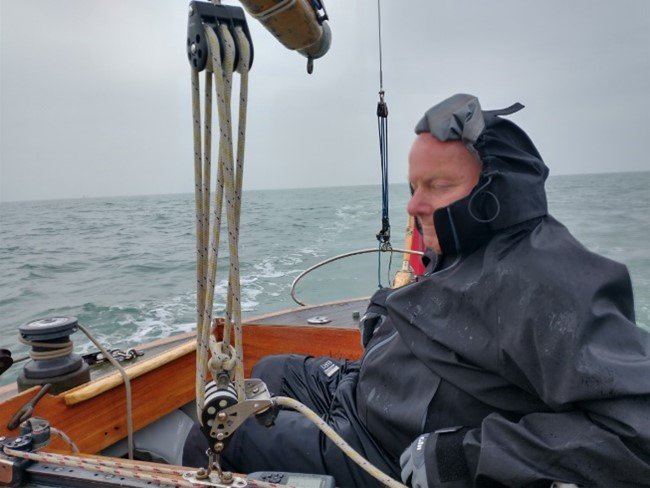
The visibility had lifted, which was a relief, as Dover approach is busy with arriving and departing ferries which can appear very suddenly. The Dover VHF channel is manned by intimidating crisp chaps and we have “history” here “Small white sailboat please respond.” Who us? Swiftly followed by the Harbour Master’s launch. “Please indicate your intentions, didn’t you hear us calling you? Oops, very sorry”. So it was with some relief that on the first time of asking, we were cleared to enter the inner harbour from the North Entrance for transit to the yacht basin at 2030, where we gratefully moored up. The Harbour Master had moved from his convenient but dingy office at the top of the gangway, to a shiny new HQ some distance away, overlooking the harbour. This would have been ideal for the planned new yacht moorings, which sadly and expensively, proved unsuitable due to wash. By now quite tired and a bit grumpy we trekked to the office and were checked in by the smartly uniformed staff. An unexpected bonus was that a new restaurant, The Dover Patrol, was right next door so we tramped over, shed our wet oilskins and ordered hot food and cold wine. There was a rather melancholy air about the place with a few other diners and our rather sweet but gormless waitress confessed that it was her first day and we were her first guests. We tipped well and headed to the boat and bed. A long and not very enjoyable day at sea.

Day 2 Tuesday July 13th Dover to Royal Sovereign Marina
We made an early start to catch the tide which swept us along the coast at a heartening 6Knts +. A welcome contrast to previous years when we had crept along at 2/3 knts. Dungeness was soon abeam.
Here, we encountered the first of the East going tide. But not before being forced to take a hitch out to sea to skirt the edge of the no-go firing zone. There was a friendly Easterly breeze to assist us on our way and we made good progress across under grey skies towards Rye Bay and past Hastings until finally arriving at Eastbourne and the lock gates of the Marina, before 1700. A good trip. Despite our declaration to be a difficult to manoeuvre, elderly sail boat, we were assigned an inside berth requiring docking skills well outside our comfort zone. After a brief grounding within the dock (skipper error), we spotted a friendly berth holder who took our lines as we slide untidily and defiantly into the nearest vacant slot. There was definitely a whiff of wacky baccy about the chap, but he was friendly, helpful and chatty. Live aboard folk tend to march to a different tune. Once finally tied up, we hit the warm and welcoming shower block then headed off for food. The marina is surrounded by apartment buildings and the restaurants are at the far top corner. The Jolly Italian was sadly shuttered and dark, a casualty of Covid. However, the Thai place next door was bustling. As our waiter gleefully declaimed, “They go bust, now we get all customers”. Unfortunately, this also meant that the food service was disastrously slow and the two sailors were less and less jolly as the minutes stretched by. Finally, the food arrived which we scoffed quickly then headed for our bunks. Another long day afloat but a much better one.
Day 3 Royal Sovereign Marina to Cowes
Having carefully considered the forecast of 18 / 25 NW. We locked out for an early 0600 start with reefed main and a 1996 Ratsey blade jib to catch the last of the West going tide.
We enjoyed a nice fetch to Beachy Head before heading West on what turned into a full beat. The sail set up was good and the boat was well balanced as we thrashed our way along on tacks into the shore and out to sea. Initial progress faded as the tide turned against us at 1000. The combined wind and tide were quite rough but the old girl handled it well and we felt a sense of confidence as we tramped along slowly ticking off the Passing landmarks: Cuckmere River, Sleaford, Newhaven, Peacehaven. Finally, the wind swung and the bow lifted onto a fetch. Relief. By early afternoon the tide had turned the sun was shining and we were starting to make good progress.
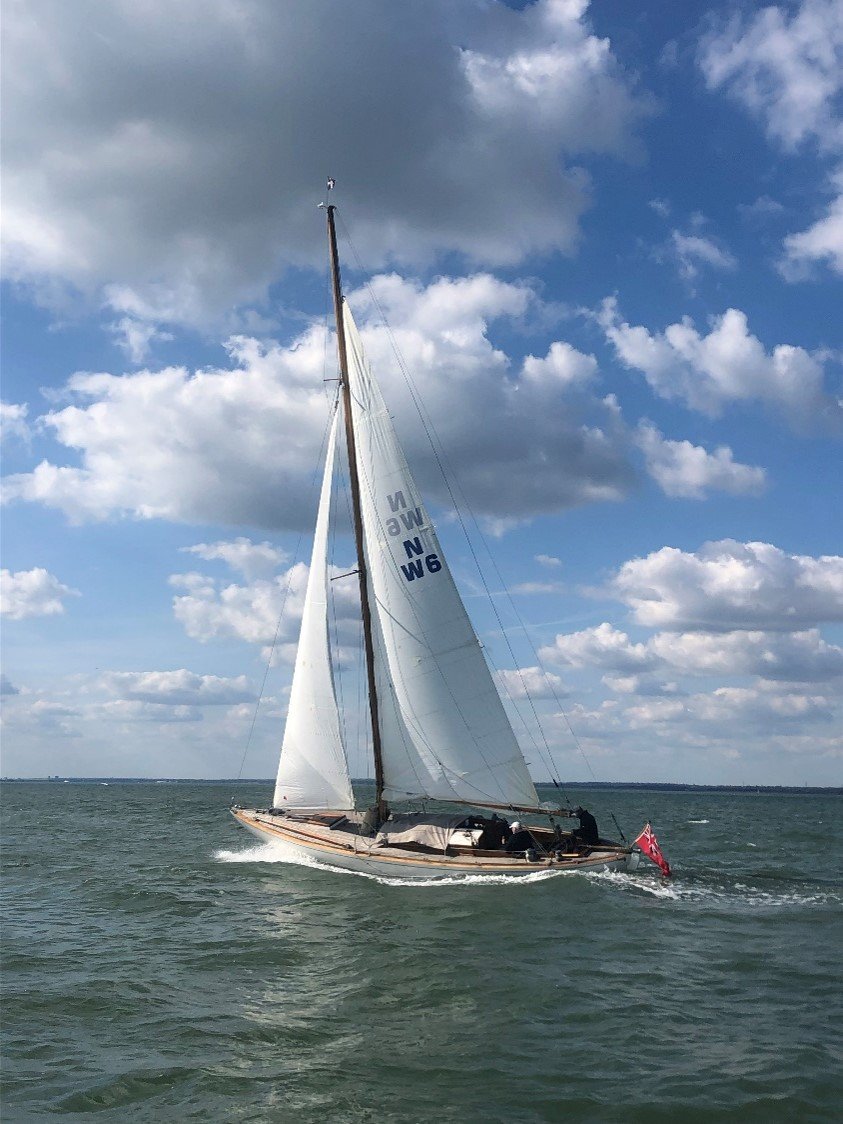
There was time for a hot lunch, cold beer and yarns of past Regattas, passages, and sailing experiences, as we headed steadily towards the second essential point on any South Coast passage, Selsey Bill. The plan was to nip through the Looe between Boulder and The Street buoys. The tide was favourable and the now friendly wind sped us along to make our waypoint by mid-afternoon. Once past, we put in a Northerly tack up past Cross Ledge, which set us up nicely for a fetch to the Fort. Once into the Solent we eased sheets for a cracking sail up the South Channel. Off Osborne Bay a large sleek rib arrived with a cheery Bob Gatehouse at the wheel to welcome us to the Solent. Bob is an Associate BCYC member, owner of Bravade, a shiny modern 6M, and all around good egg. Spirits were high.
We made the Yacht Haven by late afternoon after the best sailing day of the passage. Once safely docked – no dramas here thankfully – we headed for The Anchor for food and beer. Later we treated ourselves to a decent curry with our Cowes based friends and racing crew, Colin Lloyd and wife Geraldine, who is on the Wine Committee at The Royal Thames. She insisted on a bottle of Mateus Rose. A Classic wine for a Classic crew.
A very good finish to 172 miles of passage making, over three long three days afloat.

NoW for some racing!

Venya Goes Home
The delivery crew from Suffolk, Chis Mannion, had not been able to do the return leg. As the week wore on my mounting concern at not having a crew was solved by an appeal on social media – who knew? – which produced one Josh Dekker a “nice young man” and freshly minted, engineering graduate from Southampton University who was crewing on Border Legend, a recently relaunched and very beautiful McGruer ketch. It had been his first experience on a big boat and as he had the time and a taste for a bit more adventure, he fancied the cruise along the South Coast and across the estuary to Suffolk. Having him signed on was a big relief. Happy days beckoned.
The forecast for Saturday was a brisk Easterly so we remained in Cowes, to enjoy a leisurely breakfast on the High Street. After carrying out some essential boat tasks, a half day holiday was declared and we headed to lunch at the RORC to meet up with friends. It was a perfect sunny afternoon and we whiled away the time discussing sailing techniques and tactics with David Myatt a BCYC stalwart and 8M owner from Jersey. So much better than crashing into an Easterly, no?
Day 1 Sunday July 25th Cowes to Royal Sovereign

Early 0600 start to catch the East flowing tide. The wind had swung North, much better, and we set off down the Solent in a light rain, past the Forts, enjoying a cooked breakfast underway. It is a tradition that we eat well while passage making. We were through the Looe before the tide turned at noon.
Although it was a grey overcast day we made good time on the long-haul past Bognor, Littlehampton, Worthing and Brighton.
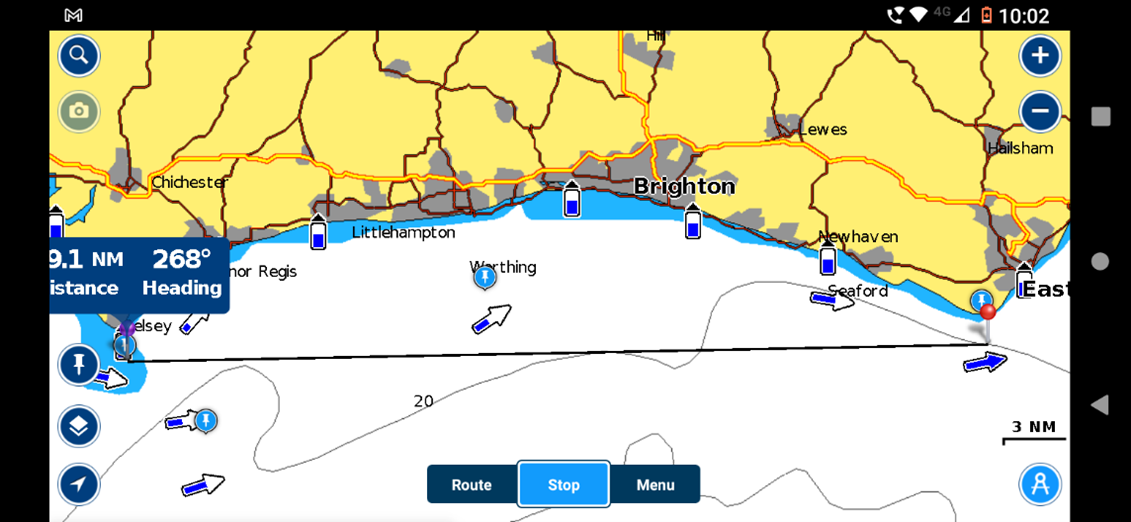
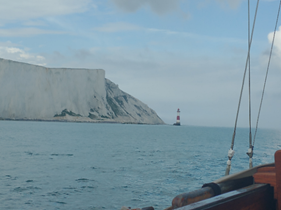
Although it was a grey overcast day we made good time on the long-haul past Bognor, Littlehampton, Worthing and Brighton. Newhaven and Seaford held no worries on the return leg and we reached Beachy Head at slack water.
This time the officials at the marina were kind and we were given an outside berth on an accessible pontoon. Oh the relief. After topping up with fuel and availing ourselves of the comfortable shower block, we headed back to the Thai this time thankfully with much improved service. We put in an early night.
Day 2 Monday July 26th Royal Sovereign to Ramsgate

We locked out at 0600 and set off eastwards against the tide but with a friendly NW wind to help us along. The weather was overcast and visibility was about 1½ miles. The tide changed mid-morning and we made the point at Dungeness on a rapidly building flood.
The trip North went well under leaden skies into a building wind, and for the first time we encountered other yachts also on passage. We passed Dover on the last of the flood and hardened up to encounter the first of the foul tide. Josh was helming and inclined to a course towards the shore, to get out of the tide.
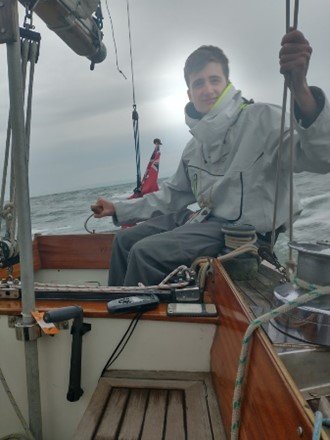
As he did not know the waters and had not consulted the chart, I pointed out that it was not a good idea to steer where you did not know exactly what lay below as well as ahead. The transition from a dinghy sailor to a cruising sailor requires time and experience and occasional gentle guidance from an old salt. Once that was understood, we continued to make steady but slowing progress, leaving the notorious Goodwin buoys to starboard. We ticked them off, one by one, until we finally reached East Brake which marked the beginning of the Channel into Ramsgate.
The breeze has risen to 18/20 knts and we had a bouncy trip into the shelter of the harbour, arriving at a reasonable 1700 after a good trip of 60nm. Ramsgate is a busy base for wind farm service vessels and a popular port for continental yachts. We were given a berth near the entrance with an easily accessible mooring. There was an astonishing amount of seagull poop on the dock, and as it happened, we were tied up ahead of a boat from Aldeburgh, Small world. Plan A was dinner at the popular Italian on the hill. However, they were so popular that they were fully booked. The shower block is a short walk from the harbour and reflects its municipal heritage. Slightly shabby – but the water was hot, and as it was now a lovely sunny evening, we decided to stroll into town to see what was available. There were reminders of Ramsgate’s past maritime glory but the town now appeared to attract mostly bikers roaring about noisily. There is the same vague air of menace as is found in Key West but without the style. We spotted a Gelato with a simple but promising menu and were able to obtain a table. We were in fact the only diners, so no worry about reservations. The food was surprisingly good and Il Padron and La Padrona, both well into their 70s, were charming and made us sailors feel very welcome. Well-fed and in the mood for sophistication, the skipper splashed out on espressos and Grappas, before we strolled back to the boat, feeling relaxed after a long day afloat. Tomorrow, the Estuary.
Day 3 Tuesday July 27th
Another early start at 0600. With the tide against us we made slow progress towards North Foreland.
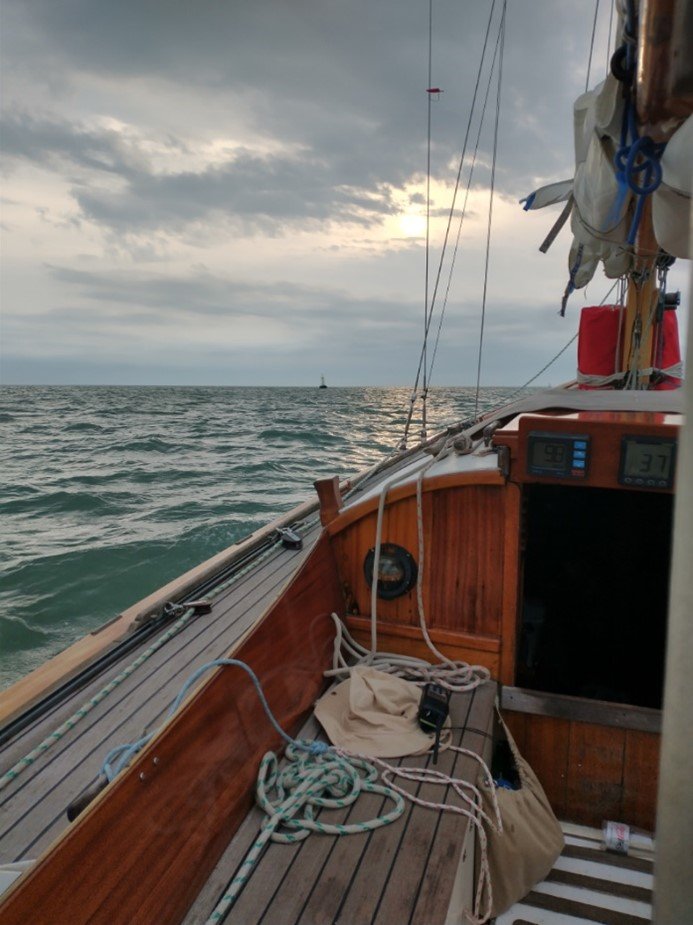
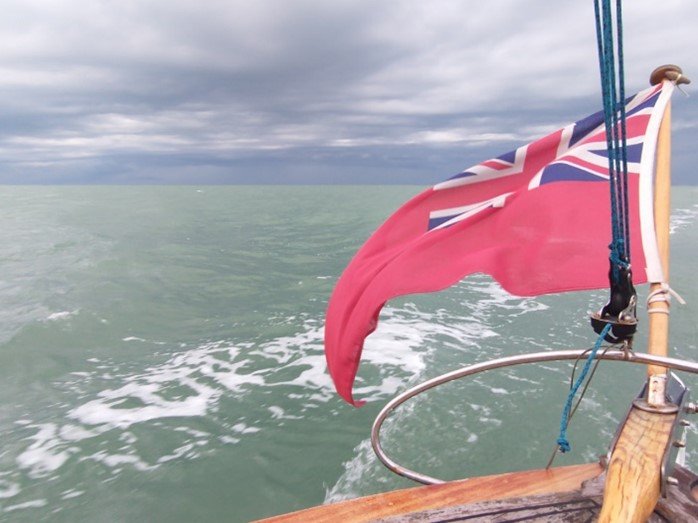
Off to the East alarming cloud banks threatened dirty weather. Fortunately, they stayed in the East, and we headed North in relative peace.
This was the story of the day as we bucked the tide, tracking north across the estuary under grey skies with a light following wind, which was useless for sailing, until almost 1400. This saw us through the windfarm which was a trickier passage than the one South as the echo sounder had ceased operating and the depth was quite shallow. We paid close attention to our position on the ever-helpful Navionics and enjoyed a better slant of wind once we made a more Easterly heading up the Black Deep before we finally encountered the first of the friendly ebb near Sunk Head Tower.
We cranked on the revs to get us into Harwich and up the Orwell to Suffolk Yacht Harbour as the young Josh had to catch a train in order to be at home on Wednesday morning for a vital online job interview. We made the harbour by 1500 and Mrs Gilday was on hand to rush him to the train station. We swiftly moored up near the entrance.
It was a relief to be safely back in Suffolk at the end to a trouble-free passage.
We had enjoyed some spirited racing during the BCYC Regatta, and we had made it to Cowes and back home, as planned.
This is what owning a Classic sailboat is all about.
Postscript
Enraged by the slow progress that occurred in anything but favourable conditions, I have installed a 25hp Beta engine augmented by a three blade propellor, to replace the puny 16hp two blade set up. Stay tuned for 2022, when we fully expect to be water skiing on passage.
THE END

Annual General Meeting & Dinner
Annual General Meeting & Dinner
Friday November 26 at Royal Thames
Meeting starts at 18:00
Dinner 20:00
Spirit 52 Oui Fling Wins British Classic Week 2021
This year’s British Classic Week, hosted by British Classic Yacht Club (BCYC), attracted 50 classic sail and motor yachts to Cowes for a week of sunshine, sailing and socialising. Despite challenging light conditions at the start of the week, the Royal Yacht Squadron (RYS) race committee led by Race Officer Dai Prichard successfully went ahead with all six races in the series, as well as the annual Ladies’ Race.

Above: Baron Irvine Laidlaw racing Spirit 52 Oui Fling
The BCYC Trophy for the regatta overall winner was won by Baron Irvine Laidlaw and his Spirit 52, Oui Fling. On behalf of Oui Fling, Gareth Griffiths commented, “Firstly, thanks from the Oui Fling crew have to go to all those that organised such a fantastic event. Considering the challenging conditions, to be able to get all races completed was a remarkable achievement.”
As a team we were very happy to face a tough challenge posed by some superb competition. Talented crews and well-prepared yachts throughout the fleet were clearly demonstrated in the results by having a number of alternate winners in all sizes of yachts on different days.”

Above: champagne sailing in the Solent
Gareth continued, “Considering what we have all faced in the last twelve months, it was so wonderful to be back on the race course in the throws of quality competition. The crew of Oui Fling really look forward to the next regatta and hope very much that everyone will continue to attend.”
Cowes basked in sunshine for the duration of this year’s British Classic Week as yacht owners and crews were tested in light winds and the notoriously challenging Solent tides. The two longer passage races (sponsored by Classic Boat magazine and Spirit Yachts respectively) took place at the end of the week, when competitors enjoyed winds of up to 17knots and some classic champagne sailing.

Above: gaff cutter Kelpie
Despite the lack of a lead sponsor, the regatta delivered on the social programme as well as on the water. Guests enjoyed hospitality in the regatta marquee at Cowes Yacht Haven, as well as a variety of social events, including the traditional drinks at the Royal Yacht Squadron, which took place free of Covid restrictions on 19th July. Guests partied late into the evening at the popular Pontoon Party sponsored by Classic Boat magazine, which this year included dockside Dark and Stormies from Hattiers Rum and gin and tonics by Dartmouth Gin.

Above: the lively Tuesday evening Pontoon Party sponsored by Classic Boat magazine
Regatta entertainment also included a complimentary party with BBQ and live music hosted by the owner of Kim Holman designed yacht Stiletto, which celebrates her 60th anniversary this year. Suffolk-based brewery Adnams provided champagne for the daily prize winners and delivered cold Kobold lagers direct to the yachts on the dock after Sunday’s racing. On Thursday, the regatta BRIG RIB was out on the water delivering Hattiers Rum Dark and Stormies, and gin and tonics by Dartmouth Gin direct to yachts crossing the finish line.

Above: a BRIG RIB was at the finish line of the long inshore race to deliver Dartmouth gin and Hattiers Rum
British Classic Week 2019 regatta overall winner and owner of Whooper, Giovanni Belgrano, commented,
“It’s been fantastic to be back at British Classic Week, we are so grateful to be back here, with our friends and crew, and to see the other beautiful boats. Even without a title sponsor, the regatta is still a class act. To have cold beers brought to you on the boat after some good racing; it really doesn’t get better than that!”

Above: crew enjoying cold Adnams Kobold lager after racing on Sunday
Further event support came from OneSails GBR, which sponsored a day’s racing, as well as Suffolk Yacht Harbour and traditional chandlery Classic Marine. Also new for 2021 was the regatta’s charity partner, Tall Ships Youth Trust. The charity was at the event onboard one of its Challenger yachts, raising awareness of the valuable work carried out to support disadvantaged and disabled young people across the UK.
Katie Craven (18), who has benefitted from the charity’s support and who spoke at the regatta prize-giving dinner ahead of a fundraiser commented, “The week was an amazing opportunity to meet loads of amazing people that I never thought I would meet. I had a smashing time on the water racing in the Ladies’ Race and I got to show off my skills that Tall Ships Youth Trust taught me, and we smashed it! I’m so happy I had this opportunity and would love to do it again.”

Above: the team from Tall Ships Youth Trust
On Friday evening, guests and prize winners celebrated a vibrant week on the water and ashore at the final prize giving dinner. Regatta overall winner Oui Fling also won Class 1, whilst 8mR Helen sailed a near-perfect week to win Class 2 and take home both the Best Placed Metre Boat and the Ladies’ Race trophies.
Class 3 was won by BCYC Regatta Chairman Michael Briggs in his Clyde Linear 30 Mikado, and a highly competitive Class 4 was won by Stiletto.
Best placed gaffer was awarded to the beautiful gaff cutter Kelpie, and best presented new entrant was won by the recently restored sloop Clarionet. Voted for by regatta competitors, the overall Je Ne Sais Quoi trophy was won by Spirit 52 Happy Forever.

Above: Spirit 52 Happy Forever
BCYC Commodore Jonathan Dyke commented, “With the challenges presented by Covid and the lack of a title sponsor, the planning phase of the regatta was tough at times. Thanks must go to all our sponsors and regatta organisation team for successfully delivering a truly fantastic event. The dock was buzzing all week with people delighted to be back out on the water, sailing their beautiful boats and catching up with friends old and new. We look forward to seeing everyone back in Cowes for next year’s regatta from 16th – 23rd July.”

Above: the famous ketch Stormvogel, winner of the 1961 Fastnet Race
Full list of winners:
OVERALL WINNER: OUI FLING
CLASS 1
1ST OVERALL: OUI FLING
2ND OVERALL: FLIGHT OF UFFORD
3RD OVERALL: HAPPY FOREVER
CLASS 2
1ST OVERALL: HELEN
2ND OVERALL: LAK II
3RD OVERALL: CETEWAYO
CLASS 3
1ST OVERALL: MIKADO
2ND OVERALL: WHOOPER
3RD OVERALL: SUNMAID V
CLASS 4
1ST OVERALL: STILETTO
2ND OVERALL: KAJSA
3RD OVERALL: CERESTE
OVERALL WINNER NOT THE NAB TOWER RACE (SPONSORED BY SPIRIT YACHTS): CHLOE GISELLE
LINE HONOURS NOT THE NAB TOWER RACE: CHLOE GISELLE
OVERALL WINNER LONG INSHORE RACE (SPONSORED BY CLASSIC BOAT): LAK II
BEST PLACED GAFFER: KELPIE
BEST PLACED METRE BOAT: HELEN
LADIES RACE: HELEN
SEAMANSHIP AWARD: GWENHYFAR
BEST PRESENTED NEW ENTRANT: CLARIONET
STIFF DRINK AWARD: INFANTA
JE NE SAIS QUOI:
OVERALL WINNER: HAPPY FOREVER
CLASS 1: HAPPY FOREVER
CLASS 2: LUTINE
CLASS 3: CLARIONET
CLASS 4: CHRYSTAL II
CRUISING CLASS: CROIX DES GARDES
MOTOR BOATS: CARINA
WINNING LOG: KINGFISHER
Club Cruising Log 2021
This summer when you are enjoying the lovely British summer, and cruising around the coast, do remember to write up the log of your voyage including some photos, and send it in.
Last year was the inauguration of the Kingfisher Cup, for the best Log, generously donated by our Rear Commodore Lord Briggs and, ahem, won by the log of a yacht called Kingfisher and owned by Michael. We were fortunate to have Rob Peake of Classic Boat as judge and he has kindly agreed to repeat his role again this year, so get planning your cruise, sharpen up your pencils, dust off the box brownie and get busy writing.
The winning entry will be announced and awarded at the Annual Dinner in November. For inspiration, the three entries submitted in 2020 are found below.